£90.38

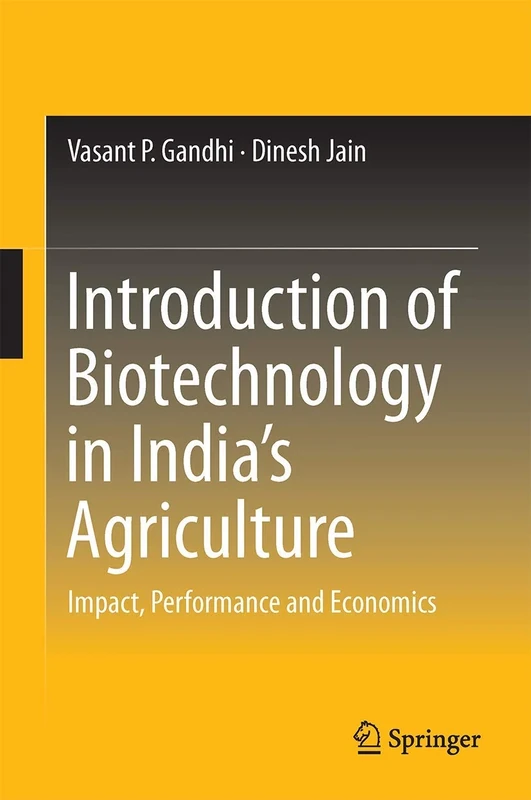
Springer Introduction of Biotechnology in India’s Agriculture: Impact, Performance and Economics

White

Price data last checked 56 day(s) ago - refreshing...

View at Amazon

We'll watch every seller, every day. One email when your price arrives.

It has never been this cheap. We have no record of a lower price.

£90 today · cheaper than every other day in the last 3 months

NEW HERE?

Amazon shows you one price. We show you all of them.

Tosheroon watches Amazon prices so you don't have to. Every product on Amazon has a price history — we make it visible. Set the price you'd actually pay, and we'll email you the second it gets there. No app, no account, one email.

WHAT'S ON THIS PAGE

↓ Price chart
when this has been cheap or pricey
↓ Forecast
where the price is heading next
↓ Statistics
all-time high & low, recent range
↑ Price alert
name your number, we'll email you

Price History & Forecast

Grey patches = out of stock. Cheaper = lower on the chart. Hover for exact prices.

Last 35 days · 35 data points (no recent data)

Historical
Generating forecast…
£90.38 £85.86 £87.67 £89.48 £91.28 £93.09 £94.90 10 June 2026 18 June 2026 27 June 2026 05 July 2026 14 July 2026

Price Distribution

Price distribution over 35 days • 1 price levels

Days at Price
35 days 0 9 18 26 35 £90 Days at Price

Price Analysis

Most common price: £90 (35 days, 100.0%)

Price range: £90 - £90

Price levels: 1 different prices over 35 days

Description

Biotechnology can bring major breakthroughs in agriculture. The book examines the experience of introduction of biotechnology in Indian agriculture, specifically, examining the performance of Bt cotton versus non-Bt cotton across India’s major cotton states, namely Andhra Pradesh, Gujarat, Maharashtra and Tamil Nadu, which together account for nearly 70 percent of the country’s cotton production. Major advances in biotechnology have made it possible to directly identify genes, determine their functions, and transfer them from one organism to another. The advances have spawned many technologies and Bt cotton is one important outcome. Bt cotton has become one of the most widely cultivated transgenic crops and is currently grown in 21 countries - 11 developing and 10 industrialized countries. The Government of India was relatively late in permitting biotechnology, only approving the cultivation of three transgenic Bt cotton hybrids from April 2002. Many concerns were raised about their performance there was strong opposition from some quarters. In India, Gujarat and Maharastra were the first states to adopt them, followed by Andhra Pradesh, Karnataka, Tamil Nadu and Madhya Pradesh. Based on a sample of 694 farming households, the book examines and analyzes the performance on the yields, pesticide costs, seed costs, overall production costs and profits. It also reports on the environmental impacts, satisfaction with the technology and ways of improving its performance. From the Back Cover Biotechnology can bring major breakthroughs in agriculture. The book examines the experience of introduction of biotechnology in Indian agriculture, specifically, examining the performance of Bt cotton versus non-Bt cotton across India’s major cotton states, namely Andhra Pradesh, Gujarat, Maharashtra and Tamil Nadu, which together account for nearly 70 percent of the country’s cotton production. Major advances in biotechnology have made it possible to directly identify genes, determine their functions, and transfer them from one organism to another. The advances have spawned many technologies and Bt cotton is one important outcome. Bt cotton has become one of the most widely cultivated transgenic crops and is currently grown in 21 countries - 11 developing and 10 industrialized countries. The Government of India was relatively late in permitting biotechnology, only approving the cultivation of three transgenic Bt cotton hybrids from April 2002. Many concerns were raised about their performance there was strong opposition from some quarters. In India, Gujarat and Maharastra were the first states to adopt them, followed by Andhra Pradesh, Karnataka, Tamil Nadu and Madhya Pradesh. Based on a sample of 694 farming households, the book examines and analyzes the performance on the yields, pesticide costs, seed costs, overall production costs and profits. It also reports on the environmental impacts, satisfaction with the technology and ways of improving its performance. About the Author Vasant P. Gandhi is a Professor at the Indian Institute of Management, Ahmedabad (IIMA) in India, and is currently the NABARD Chair Professor. He did his Ph.D. from Stanford University, Masters in Management from IIMA and Bachelors in Agriculture from Pantnagar. He is the Chairman of IIMA’s Centre for Management in Agriculture (CMA). He has worked with the World Bank, and the International Food Policy Research Institute (IFPRI) in Washington, and has been a Visiting Professor at the University of Sydney and the James Cook University, Australia. He has been consultant/ Advisor to FAO, the World Bank, Government of India, various state governments, Agriculture Insurance Company of India, and McKinsey & Company, various high level government committees, and is on several company Boards. His areas of research in which he has published extensively include international food and agriculture policy, technology for agricultural growth, water re

Product Specifications

Colour
White
Format
hardcover
Domain
Amazon UK
Release Date
09 August 2016
Listed Since
24 March 2016

Barcode

No barcode data available