We can't find the internet
Attempting to reconnect
Something went wrong
Hang in there while we get back on track
£47.99
This is the most expensive it has ever been. Walk away.
£48 today · previous high £48 · all-time low £46
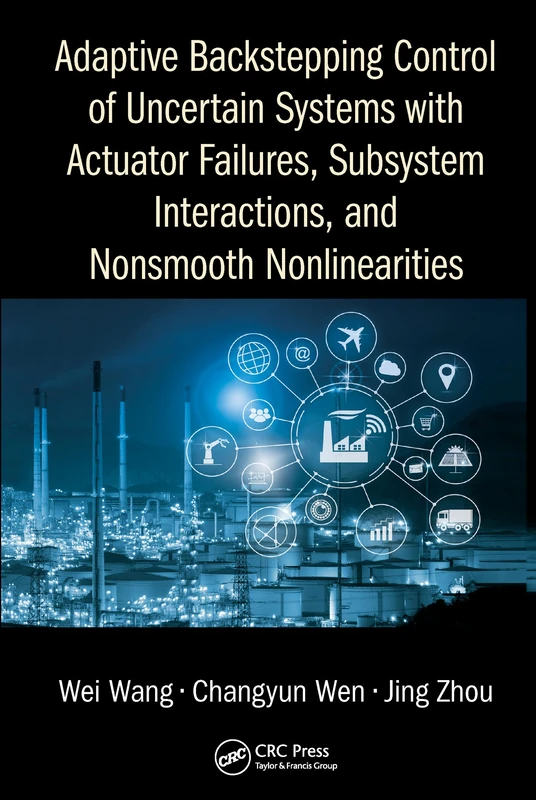
CRC Press Adaptive Backstepping Control of Uncertain Systems with Actuator Failures, Subsystem Interactions, and Nonsmooth Nonlinearities
We'll watch every seller, every day. One email when your price arrives.
Price History & Forecast
Grey patches = out of stock. Cheaper = lower on the chart. Hover for exact prices.
Last 61 days · 61 data points (no recent data)
NEW HERE?
Amazon shows you one price. We show you all of them.
Tosheroon watches Amazon prices so you don't have to. Every product on Amazon has a price history — we make it visible. Set the price you'd actually pay, and we'll email you the second it gets there. No app, no account, one email.
WHAT'S ON THIS PAGE
when this has been cheap or pricey
where the price is heading next
all-time high & low, recent range
name your number, we'll email you
Price Distribution
Price distribution over 61 days • 2 price levels
Price Analysis
Most common price: £48 (31 days, 50.8%)
Price range: £46 - £48
Price levels: 2 different prices over 61 days
Description
Product Specifications
- Brand
- CRC Press
- Format
- paperback
- ASIN
- 0367572842
- Domain
- Amazon UK
- Release Date
- 30 June 2020
- Listed Since
- 29 May 2020
Barcode
No barcode data available
Similar Products You Might Like

Control of Complex Systems: Theory and Applications
Elsevier

Advances and Applications in Sliding Mode Control systems: 576 (Studies in Computational Intelligence, 576)
Springer
Advances and Applications in Sliding Mode Control systems: 576 (Studies in Computational Intelligence, 576)
Springer

Multivariable Feedback Control Second Edition: Analysis and Design
Wiley
Adaptive Control: Algorithms, Analysis and Applications - Springer
Springer
Multivariable Feedback Control: Analysis and Design
Wiley
Discrete-Time Control System Design with Applications
Springer
Recent Results on Time-Delay Systems: Analysis and Control: 5 (Advances in Delays and Dynamics, 5)
Springer
Tracking Control of Linear Systems
CRC Press
True Digital Control: Statistical Modelling and Non-Minimal State Space Design
Wiley
Chemical and Biological Process Dynamics and Control Book
Nonlinear H2/H-Infinity Constrained Feedback Control: A Practical Design Approach Using Neural Networks (Advances in Industrial Control)
Springer
Linear Control Theory: Structure, Robustness, and Optimization (Automation and Control Engineering)
CRC Press

Trends in Nonlinear and Adaptive Control: A Tribute to Laurent Praly for his 65th Birthday: 488 (Lecture Notes in Control and Information Sciences, 488)
Springer

Mathematical Control Theory: An Introduction (Systems & Control: Foundations & Applications)
Birkhauser
Modern Control Theory: State Variable Analysis of Linear Systems and Analysis of Nonlinear Systems

Limits of Stability and Stabilization of Time-Delay Systems: A Small-Gain Approach: 8 (Advances in Delays and Dynamics, 8)
Springer
Stability and Control of Linear Systems: 185 (Studies in Systems, Decision and Control, 185)
Springer
Sliding Mode Control and Observation (Control Engineering)
Birkhauser
Virtual Equivalent System Approach for Stability Analysis of Model-based Control Systems
Springer
Advanced Discrete-Time Control: Designs and Applications: 23 (Studies in Systems, Decision and Control, 23)
Springer
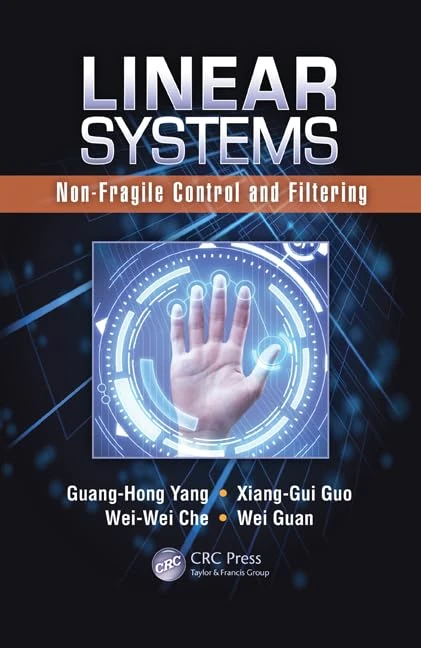
Linear Systems: Non-Fragile Control and Filtering
CRC Press
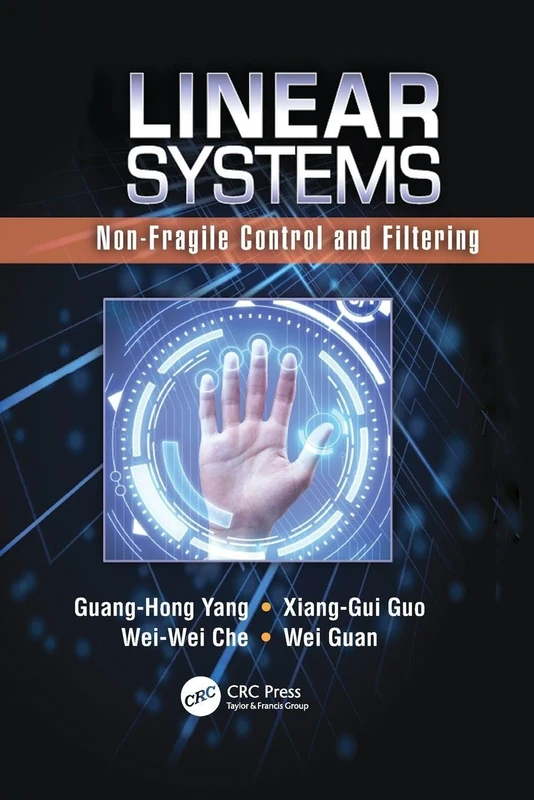
Linear Systems: Non-Fragile Control and Filtering
CRC Press

Control Theory and Design: An RH2 and RH Viewpoint
Elsevier