£46.46

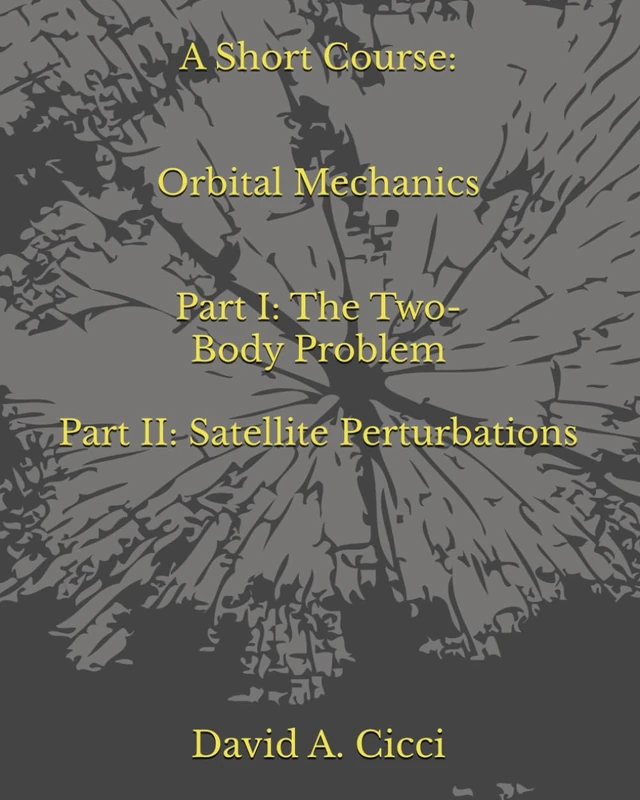
A Short Course in Orbital Mechanics: Part I: The Two-Body Problem, and Part II: Satellite Perturbations (Short Courses in Aerospace Engineering)

Price data last checked 16 day(s) ago - will refresh soon

View at Amazon

We'll watch every seller, every day. One email when your price arrives.

It has never been this cheap. We have no record of a lower price.

£46 today · cheaper than every other day in the last 3 months

NEW HERE?

Amazon shows you one price. We show you all of them.

Tosheroon watches Amazon prices so you don't have to. Every product on Amazon has a price history — we make it visible. Set the price you'd actually pay, and we'll email you the second it gets there. No app, no account, one email.

WHAT'S ON THIS PAGE

↓ Price chart
when this has been cheap or pricey
↓ Forecast
where the price is heading next
↓ Statistics
all-time high & low, recent range
↑ Price alert
name your number, we'll email you

Price History & Forecast

Grey patches = out of stock. Cheaper = lower on the chart. Hover for exact prices.

Last 75 days · 75 data points (no recent data)

Historical
Generating forecast…
£46.46 £44.14 £45.07 £46.00 £46.92 £47.85 £48.78 28 April 2026 16 May 2026 04 June 2026 22 June 2026 11 July 2026

Price Distribution

Price distribution over 75 days • 1 price levels

Days at Price
75 days 0 19 38 56 75 £46 Days at Price

Price Analysis

Most common price: £46 (75 days, 100.0%)

Price range: £46 - £46

Price levels: 1 different prices over 75 days

Description

This is a short course covering introductory and advanced topics in orbital mechanics. It focuses on both the Two-Body Problem and Satellite Perturbations. The material presented is usually covered in the first two courses in orbital mechanics except that there is no required homework, quizzes, projects, computer programs to write, or examinations. This course is structured to present the basic concepts without the in-depth theoretical background and mathematical derivations that commonly accompany an academic presentation of the subject. My intention is to introduce orbital mechanics in a simplified manner to those with no previous background in the field, or to provide a review to those who have studied the subject previously. Readers should have a familiarity with differential and integral calculus and differential equations to help understand some equations presented. The form of this short course is like the many short courses I’ve taught at government agencies and private corporations during my thirty-five-year career as an aerospace engineering professor at Auburn University. It presents the material in a simplified outline / bullet format using many understandable figures, rather than using lengthy, detailed explanations with complex mathematical derivations and proofs. It provides the practical equations that are useful to the practicing engineer working in orbital mechanics. The objectives of this short course are to: - Review coordinate systems, time and timekeeping, basic definitions, and terminology commonly used in orbital mechanics. - Present the fundamentals of two-body orbital mechanics, i.e., the study of the motion of natural and artificial bodies in space. - Review Newton’s Laws of Motion, Newton’s Law of Universal Gravitation, and Kepler’s Laws. - Describe applications of two-body orbital mechanics, including launching, ground tracks, orbital transfers, plane changes, interplanetary trajectories, and planetary capture. - Review alternate solutions to Kepler’s Problem, including the f and g function solutions and the f and g series solutions. - Present the concepts of satellite perturbation theory. - Review the theoretical and practical aspects of general perturbation theory as applied to non-spherical Earth, n-body, atmospheric drag, solar radiation pressure, Earth albedo, tides, thrusting, and relativistic effects. - Describe the concepts and applications of the Circular Restricted Problem of Three Bodies. - Present the concepts and techniques of special perturbation theory and review methods used in computing ephemerides for the Sun, Moon, and the planets. - Review the practical aspects of rocket vehicle dynamics and the optimal staging of rockets. Orbital mechanics is not easy, but it’s my goal to make it enjoyably simple once the basic laws are understood. To do so, I’ve attempted to present the difficult concepts as clearly as possible to facilitate that understanding. Completion of this short course should enhance the knowledge base of all those who read through its content. This short course is part of a series I developed as a Professor at Auburn University. Others in this series include: Orbital Mechanics, Part I: The Two-Body Problem, Orbital Mechanics, Part II: Satellite Perturbations, State Estimation and Kalman Filtering Fundamentals of Inertial Navigation and Missile Guidance If you have questions, please contact me at: ciccida@auburn.edu.

Product Specifications

Format
paperback
Domain
Amazon UK
Release Date
24 February 2022
Listed Since
26 February 2022

Barcode

No barcode data available