We can't find the internet
Attempting to reconnect
Something went wrong
Hang in there while we get back on track

£107.85
It has never been this cheap. We have no record of a lower price.
£108 today · cheaper than every other day in the last 3 months
Springer The House of Tata Meets the Second Industrial Revolution: An Institutional Analysis of Tata Iron and Steel Co. in Colonial India (Studies in Economic History)
Price data last checked 74 day(s) ago - refreshing...
We'll watch every seller, every day. One email when your price arrives.
Price History & Forecast
Grey patches = out of stock. Cheaper = lower on the chart. Hover for exact prices.
Last 17 days · 17 data points (no recent data)
Price data last checked 74 day(s) ago - refreshing...
NEW HERE?
Amazon shows you one price. We show you all of them.
Tosheroon watches Amazon prices so you don't have to. Every product on Amazon has a price history — we make it visible. Set the price you'd actually pay, and we'll email you the second it gets there. No app, no account, one email.
WHAT'S ON THIS PAGE
when this has been cheap or pricey
where the price is heading next
all-time high & low, recent range
name your number, we'll email you
Price Distribution
Price distribution over 17 days • 1 price levels
Price Analysis
Most common price: £108 (17 days, 100.0%)
Price range: £108 - £108
Price levels: 1 different prices over 17 days
Description
Product Specifications
- Brand
- Springer
- Format
- paperback
- ASIN
- 9811342121
- Category
- Books > Subjects > Business, Finance & Law > Biographies & Histories > Business & Economic History
- Domain
- Amazon UK
- Release Date
- 25 December 2018
- Listed Since
- 26 December 2018
Barcode
No barcode data available
Similar Products You Might Like
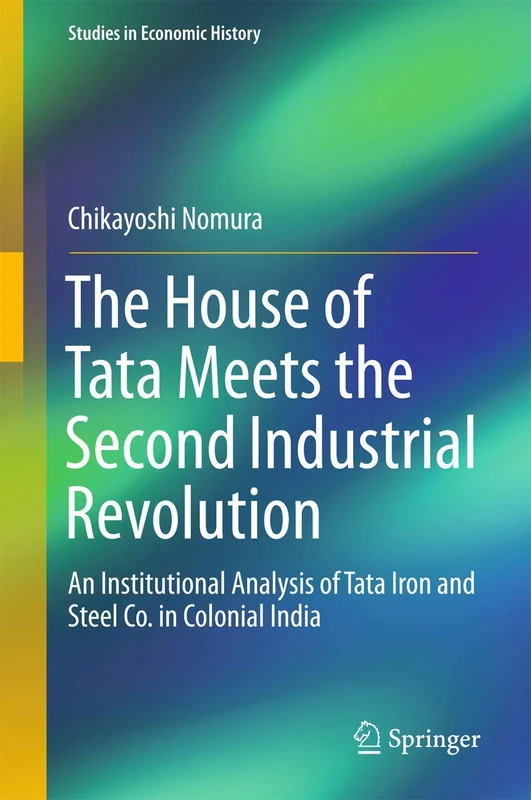
The House of Tata Meets the Second Industrial Revolution: An Institutional Analysis of Tata Iron and Steel Co. in Colonial India (Studies in Economic History)
Springer
The Indian Bourgeoisie: A Political History of the Indian Capitalist Class in the Early Twentieth Century (Library of South Asian History and Culture)
Bloomsbury

The Dynamics of Big Business: Structure, Strategy, and Impact in Italy and Spain: 22 (Routledge International Studies in Business History)
Routledge

Colonial Theories of Institutional Development: Toward a Model of Styles of Imperialism (Contributions to Economics)
Springer
Institutions and Chinese Economic Development: A Comparative Historical Approach (Routledge Explorations in Economic History)
Routledge

German Business Management: A Japanese Perspective on Regional Development Factors
Springer
The Japanese Iron and Steel Industry, 1850-1990: Continuity and Discontinuity (Studies in the Modern Japanese Economy)
MACMILLAN
German Economic and Business History in the 19th and 20th Centuries
MACMILLAN
The Archaeology of Capitalism in Colonial Contexts: Postcolonial Historical Archaeologies (Contributions To Global Historical Archaeology)
Springer
The Archaeology of Capitalism in Colonial Contexts: Postcolonial Historical Archaeologies (Contributions To Global Historical Archaeology)
Springer
Forms of Enterprise in 20th Century Italy: Boundaries, Structures and Strategies
Edward Elgar Publishing
The Story of Indian Manufacturing: Encounters with the Mughal and British Empires (1498 -1947)
MACMILLAN

Colonial Theories of Institutional Development: Toward a Model of Styles of Imperialism (Contributions to Economics)
Springer
Modern Global Trade and the Asian Regional Economy (Monograph Series of the Socio-Economic History Society, Japan)
Springer
Reassessing the Role of Management in the Golden Age: An International Comparison of Public Sector Managers 1945–1975 (Central Issues in Contemporary Economic Theory and Policy)
Springer
Ownership and Governance of Enterprises: Recent Innovative Developments (Studies in Development Economics and Policy)
MACMILLAN
Industrial Policy Economic Development I: 1947 - 2012
New Century Publications

Managing Innovation in Japan: The Role Institutions Play in Helping or Hindering how Companies Develop Technology
Springer
British Business Strategy 1945 to c.1960: How the market was made: From Cartels to Competition Policy: Oligopolistic Business in Britain after the Second World War
LAP Lambert Academic Publishing

Struggles for Survival: Institutional and Organizational Changes in Japan's High-Tech Industries
Springer

Tin and Global Capitalism, 1850-2000: A History of "the Devil's Metal" (Routledge International Studies in Business History)
Routledge

Firms and Industrial Organization in Japan
MACMILLAN
Globalization and Standards: Issues and Challenges in Indian Business (India Studies in Business and Economics)
Springer
East Asian Business in the New World: Helping Old Economies Revitalize
Elsevier