We can't find the internet
Attempting to reconnect
Something went wrong
Hang in there while we get back on track
£122.52
About as cheap as it gets — within 5% of the all-time low it hit 1 month ago.
£123 today · all-time low £120 (Sep 2026) · usually £122
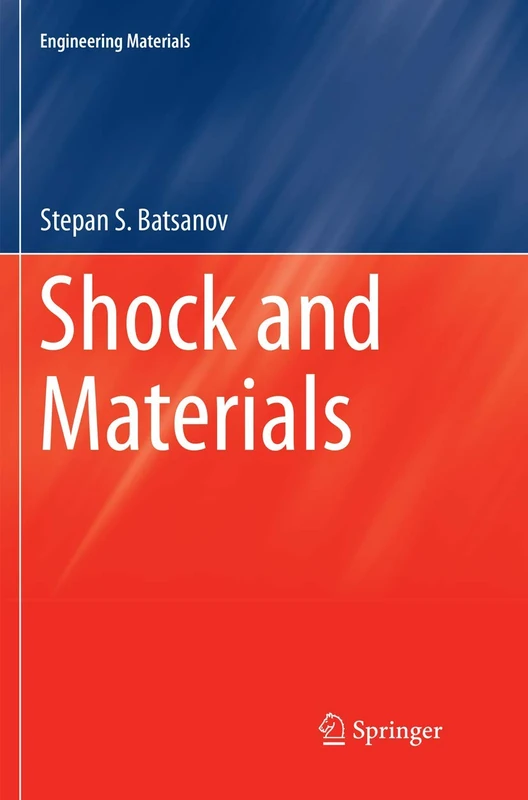
Springer Shock and Materials (Engineering Materials)
We'll watch every seller, every day. One email when your price arrives.
Price History & Forecast
Grey patches = out of stock. Cheaper = lower on the chart. Hover for exact prices.
Last 62 days · 62 data points (no recent data)
NEW HERE?
Amazon shows you one price. We show you all of them.
Tosheroon watches Amazon prices so you don't have to. Every product on Amazon has a price history — we make it visible. Set the price you'd actually pay, and we'll email you the second it gets there. No app, no account, one email.
WHAT'S ON THIS PAGE
when this has been cheap or pricey
where the price is heading next
all-time high & low, recent range
name your number, we'll email you
Price Distribution
Price distribution over 62 days • 4 price levels
Price Analysis
Most common price: £122 (18 days, 29.0%)
Price range: £120 - £124
Price levels: 4 different prices over 62 days
Description
Product Specifications
- Brand
- Springer
- Format
- paperback
- ASIN
- 981134017X
- Domain
- Amazon UK
- Release Date
- 08 February 2019
- Listed Since
- 08 February 2019
Barcode
No barcode data available
Similar Products You Might Like

Static Compression of Energetic Materials (Shock Wave and High Pressure Phenomena)
Springer

Nonlinear Elastic and Inelastic Models for Shock Compression of Crystalline Solids (Shock Wave and High Pressure Phenomena)
Springer
High-Pressure Physics (Scottish Graduate Series)
CRC Press

MATERIALS UNDER EXTREME CONDITIONS: MOLECULAR CRYSTALS AT HIGH PRESSURE
Imperial College Press
High-Pressure Crystallography: 140 (NATO Science Series II: Mathematics, Physics and Chemistry, 140)
Springer

Application of Imaging Techniques to Mechanics of Materials and Structures, Volume 4: Proceedings of the 2010 Annual Conference on Experimental and ... Society for Experimental Mechanics Series)
Springer

Effects of Explosions on Materials: Modification and Synthesis Under High-Pressure Shock Compression (Shock Wave and High Pressure Phenomena)
Springer
Shock Compression of Condensed Materials - Cambridge University Press
Cambridge University Press

Frontiers of High-Pressure Research: (Closed)): 286 (NATO Science Series B:)
Springer
Springer Nonlinear Elastic and Inelastic Models Book
Springer
High-Pressure Crystallography: 140 (NATO Science Series II: Mathematics, Physics and Chemistry, 140)
Springer

Plasticity-Damage Couplings: From Single Crystal to Polycrystalline Materials: 253 (Solid Mechanics and Its Applications, 253)
Springer

Shock-Wave Phenomena and the Properties of Condensed Matter (Shock Wave and High Pressure Phenomena)
Springer

Defect and Material Mechanics
Springer

Shock-Wave Phenomena and the Properties of Condensed Matter (Shock Wave and High Pressure Phenomena)
Springer

Multiscale Mechanics of Shock Wave Processes (Shock Wave and High Pressure Phenomena)
Springer

Fundamentals Of Materials Modelling For Metals Processing Technologies: Theories And Applications
Imperial College Press
Shock Wave Compression of Condensed Matter: A Primer (Shock Wave and High Pressure Phenomena)
Springer

Shock Compression and Chemical Reaction of Multifunctional Energetic Structural Materials (Elsevier Series in Mechanics of Advanced Materials)
Elsevier

Kunststoffe. Struktur, physikalisches Verhalten und Prüfung: Erster Band: Struktur und physikalisches Verhalten der Kunststoffe: 6 (Chemie, Physik und ... der Kunststoffe in Einzeldarstellungen, 6)
Springer

Atomistic Properties of Solids - Springer Materials Science
Springer

Springer Multiscale Phenomena in Plasticity - NATO Series 367
Springer
High-Pressure Shock Compression of Solids VII: Shock Waves and Extreme States of Matter: 7 (Shock Wave and High Pressure Phenomena)
Springer

My Journey with Shock Waves (Shock Wave and High Pressure Phenomena)
Springer