We can't find the internet
Attempting to reconnect
Something went wrong
Hang in there while we get back on track

£129.97
It has never been this cheap. We have no record of a lower price.
£130 today · cheaper than every other day in the last 3 months
Springer The Attribute of Water: Single Notion, Multiple Myths: 113 (Springer Series in Chemical Physics, 113)
We'll watch every seller, every day. One email when your price arrives.
Price History & Forecast
Grey patches = out of stock. Cheaper = lower on the chart. Hover for exact prices.
Last 18 days · 18 data points (no recent data)
NEW HERE?
Amazon shows you one price. We show you all of them.
Tosheroon watches Amazon prices so you don't have to. Every product on Amazon has a price history — we make it visible. Set the price you'd actually pay, and we'll email you the second it gets there. No app, no account, one email.
WHAT'S ON THIS PAGE
when this has been cheap or pricey
where the price is heading next
all-time high & low, recent range
name your number, we'll email you
Price Distribution
Price distribution over 18 days • 1 price levels
Price Analysis
Most common price: £130 (18 days, 100.0%)
Price range: £130 - £130
Price levels: 1 different prices over 18 days
Description
Product Specifications
- Brand
- Springer
- Colour
- White
- Format
- paperback
- ASIN
- 9811090963
- Domain
- Amazon UK
- Release Date
- 25 April 2018
- Listed Since
- 25 April 2018
Barcode
No barcode data available
Similar Products You Might Like
Electron and Phonon Spectrometrics
Springer

Membrane Biophysics: New Insights and Methods
Springer

Ion Correlations at Electrified Soft Matter Interfaces (Springer Theses)
Springer

Ion Correlations at Electrified Soft Matter Interfaces (Springer Theses)
Springer
The Hydrogen Bond and the Water Molecule: The Physics and Chemistry of Water, Aqueous and Bio Media
Elsevier

Transport and Reactivity of Solutions in Confined Hydrosystems (NATO Science for Peace and Security Series C: Environmental Security)
Springer

The Preparation of Nano Composites and Their Applications in Solar Energy Conversion (Springer Theses)
Springer
Ultrafast Dynamics of Phospholipid-Water Interfaces: Studied by Nonlinear Time-Resolved Vibrational Spectroscopy (Springer Theses)
Springer

Molecular Thermodynamics of Complex Systems: 131 (Structure and Bonding, 131)
Springer

Transport Studies of the Electrical, Magnetic and Thermoelectric properties of Topological Insulator Thin Films (Springer Theses)
Springer

Spectroscopic Investigations of Hydrogen Bond Network Structures in Water Clusters (Springer Theses)
Springer

Transport Studies of the Electrical, Magnetic and Thermoelectric properties of Topological Insulator Thin Films (Springer Theses)
Springer

Unimolecular and Supramolecular Electronics II: Chemistry and Physics Meet at Metal-Molecule Interfaces: 313 (Topics in Current Chemistry, 313)
Springer

Modeling of Nanotoxicity: Molecular Interactions of Nanomaterials with Bionanomachines
Springer

Bioinspiration: From Nano to Micro Scales (Biological and Medical Physics, Biomedical Engineering)
Springer

Ions in Water and Biophysical Implications: From Chaos to Cosmos
Springer

Design, Synthesis and Applications of One-Dimensional Chalcogenide Hetero-Nanostructures: Novel Metal Sulfide Hetero-Nanorods for Enhancing Solar Energy Conversion (Springer Theses)
Springer

Recent Advances in Complex Functional Materials: From Design to Application
Springer
Length-Scale Dependent Phonon Interactions: 128 (Topics in Applied Physics, 128)
Springer

Nanophenomena at Surfaces: Fundamentals of Exotic Condensed Matter Properties: 47 (Springer Series in Surface Sciences, 47)
Springer
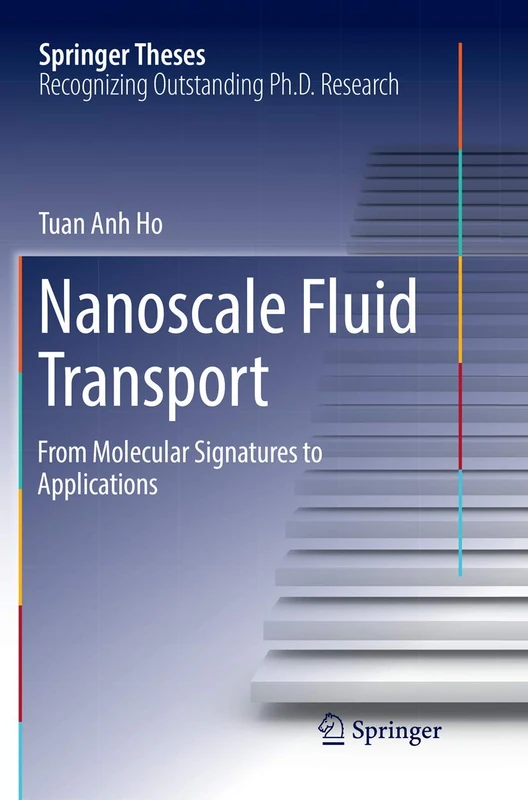
Nanoscale Fluid Transport: From Molecular Signatures to Applications (Springer Theses)
Springer

Fullerenes and Other Carbon-Rich Nanostructures: 159 (Structure and Bonding, 159)
Springer

In-Situ Microscopy in Materials Research: Leading International Research in Electron and Scanning Probe Microscopies
Springer
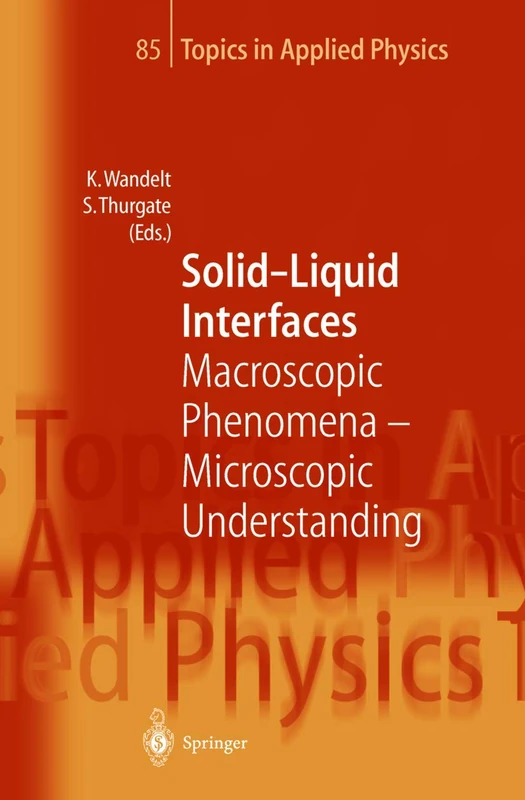
Solid-Liquid Interfaces: Macroscopic Phenomena ― Microscopic Understanding: 85 (Topics in Applied Physics, 85)
Springer