£84.31

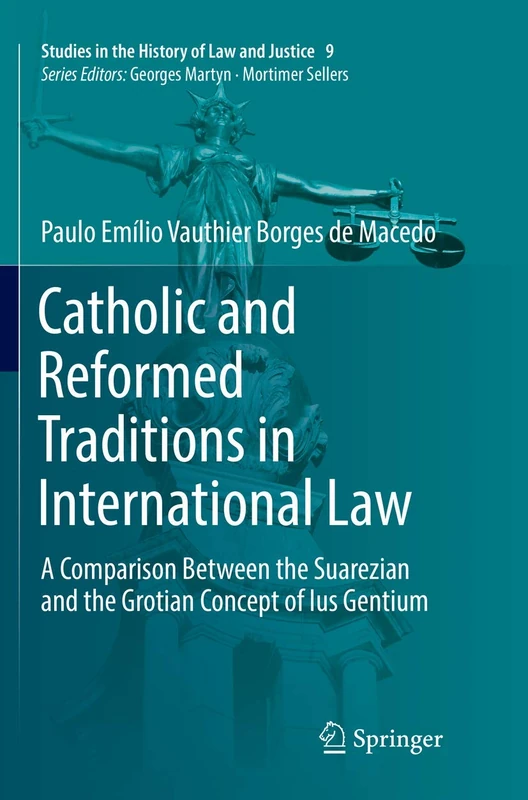
Springer Catholic and Reformed Traditions in International Law: A Comparison Between the Suarezian and the Grotian Concept of Ius Gentium: 9 (Studies in the History of Law and Justice, 9)

Price data last checked 11 day(s) ago - will refresh soon

View at Amazon

We'll watch every seller, every day. One email when your price arrives.

This is the most expensive it has ever been. Walk away.

£84 today · previous high £84 · all-time low £84

NEW HERE?

Amazon shows you one price. We show you all of them.

Tosheroon watches Amazon prices so you don't have to. Every product on Amazon has a price history — we make it visible. Set the price you'd actually pay, and we'll email you the second it gets there. No app, no account, one email.

WHAT'S ON THIS PAGE

↓ Price chart
when this has been cheap or pricey
↓ Forecast
where the price is heading next
↓ Statistics
all-time high & low, recent range
↑ Price alert
name your number, we'll email you

Price History & Forecast

Grey patches = out of stock. Cheaper = lower on the chart. Hover for exact prices.

Last 80 days · 80 data points (no recent data)

Historical
Generating forecast…
£84.31 £83.72 £83.85 £83.98 £84.10 £84.23 £84.36 26 April 2026 15 May 2026 04 June 2026 24 June 2026 14 July 2026

Price Distribution

Price distribution over 80 days • 1 price levels

Days at Price
80 days 0 20 40 60 80 £84 Days at Price

Price Analysis

Most common price: £84 (80 days, 100.0%)

Price range: £84 - £84

Price levels: 1 different prices over 80 days

Description

This book compares the respective concepts of the law of nations put forward by the Spanish theologian Francisco Suárez and by the Dutch jurist Hugo Grotius. This comparison is based on the fact that both thinkers developed quite similar notions and were the first to depart from the Roman conception, which persisted throughout the entire Middle Ages and the early Renaissance. In Rome, jus gentium was a law that applied to foreigners within the Empire, and one which was often mistaken for Natural Law itself. These two features can be found even in the works of writers such as Francisco de Vitória and Alberico Gentili. In Suárez and Grotius, the law of nations is applicable to an extra-national domain and inarguably becomes positive law. Yet, it also contains an ethical element that prevents it from transforming into a mere reflection of state interests. This work argues that this resemblance is hardly a coincidence: Grotius has read Suárez, and that influence has modified the foundations of his early thoughts on jus gentium. This should not be taken to imply that the Dutch jurist wasn’t original: in both authors, the definition of the law of nations pursues his own internal logic. Nevertheless, Suárez’s oeuvre allowed Grotius to solve a fundamental problem touched on in his early writings that had remained unanswered. Accordingly, his oeuvre promises to clarify one of the most significant moments in the History of International Law. From the Back Cover This book compares the respective concepts of the law of nations put forward by the Spanish theologian Francisco Suárez and by the Dutch jurist Hugo Grotius. This comparison is based on the fact that both thinkers developed quite similar notions and were the first to depart from the Roman conception, which persisted throughout the entire Middle Ages and the early Renaissance. In Rome, jus gentium was a law that applied to foreigners within the Empire, and one which was often mistaken for Natural Law itself. These two features can be found even in the works of writers such as Francisco de Vitória and Alberico Gentili. In Suárez and Grotius, the law of nations is applicable to an extra-national domain and inarguably becomes positive law. Yet, it also contains an ethical element that prevents it from transforming into a mere reflection of state interests. This work argues that this resemblance is hardly a coincidence: Grotius has read Suárez, and that influence has modified the foundations of his early thoughts on jus gentium. This should not be taken to imply that the Dutch jurist wasn’t original: in both authors, the definition of the law of nations pursues his own internal logic. Nevertheless, Suárez’s oeuvre allowed Grotius to solve a fundamental problem touched on in his early writings that had remained unanswered. Accordingly, his oeuvre promises to clarify one of the most significant moments in the History of International Law. About the Author Paulo Emílio Vauthier Borges de Macedo is an associate professor of International Law at the University of Rio de Janeiro (UERJ), Vice-Coordinator of the Master and Doctorate Programme; Visiting Professor of Andrzej Frycz Modrzewski Krakow University; Visiting Researcher at Murdoch University; Legal Adviser at the Brazilian Navy War School (EGN); Editor-in-chief of the Rio de Janeiro University Law School Journal; President of the Brazilian section of Communio Journal (Catholic International Journal of Theology and Culture).

Product Specifications

Format
paperback
Domain
Amazon UK
Release Date
12 May 2018
Listed Since
14 May 2018

Barcode

No barcode data available