£86.31

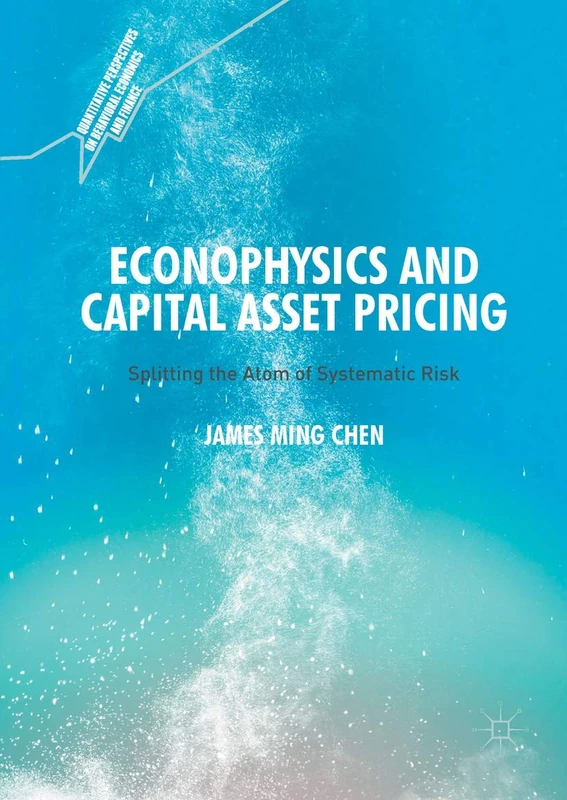
Springer Econophysics and Capital Asset Pricing: Splitting the Atom of Systematic Risk (Quantitative Perspectives on Behavioral Economics and Finance)

Price data last checked 14 day(s) ago - will refresh soon

View at Amazon

We'll watch every seller, every day. One email when your price arrives.

It has never been this cheap. We have no record of a lower price.

£86 today · cheaper than every other day in the last 3 months

NEW HERE?

Amazon shows you one price. We show you all of them.

Tosheroon watches Amazon prices so you don't have to. Every product on Amazon has a price history — we make it visible. Set the price you'd actually pay, and we'll email you the second it gets there. No app, no account, one email.

WHAT'S ON THIS PAGE

↓ Price chart
when this has been cheap or pricey
↓ Forecast
where the price is heading next
↓ Statistics
all-time high & low, recent range
↑ Price alert
name your number, we'll email you

Price History & Forecast

Grey patches = out of stock. Cheaper = lower on the chart. Hover for exact prices.

Last 77 days · 77 data points (no recent data)

Historical
Generating forecast…
£86.31 £81.99 £83.72 £85.45 £87.17 £88.90 £90.63 01 May 2026 20 May 2026 08 June 2026 27 June 2026 16 July 2026

Price Distribution

Price distribution over 77 days • 1 price levels

Days at Price
77 days 0 19 39 58 77 £86 Days at Price

Price Analysis

Most common price: £86 (77 days, 100.0%)

Price range: £86 - £86

Price levels: 1 different prices over 77 days

Description

This book rehabilitates beta as a definition of systemic risk by using particle physics to evaluate discrete components of financial risk. Much of the frustration with beta stems from the failure to disaggregate its discrete components; conventional beta is often treated as if it were "atomic" in the original Greek sense: uncut and indivisible. By analogy to the Standard Model of particle physics theory's three generations of matter and the three-way interaction of quarks, Chen divides beta as the fundamental unit of systemic financial risk into three matching pairs of "baryonic" components. The resulting econophysics of beta explains no fewer than three of the most significant anomalies and puzzles in mathematical finance. Moreover, the model's three-way analysis of systemic risk connects the mechanics of mathematical finance with phenomena usually attributed to behavioral influences on capital markets. Adding consideration of volatility and correlation, and of the distinct cash flow and discount rate components of systematic risk, harmonizes mathematical finance with labor markets, human capital, and macroeconomics.  Review “The book is more suitable for market practitioners than for financial mathematicians since the mathematical description is relatively well known. It can, however, shed new light on the well-known and widely used CAPM and maybe motivate some practitioners to adopt more accurate models of capital asset pricing. Therefore I recommend this book for readers who have not encountered econophysics yet and who are not familiar with advanced mathematical models of asset pricing.” (Jan Korbel, Mathematical Reviews, October, 2019) From the Back Cover This book rehabilitates beta as a definition of systemic risk by using particle physics to evaluate discrete components of financial risk. Much of the frustration with beta stems from the failure to disaggregate its discrete components; conventional beta is often treated as if it were "atomic" in the original Greek sense: uncut and indivisible. By analogy to the Standard Model of particle physics theory's three generations of matter and the three-way interaction of quarks, Chen divides beta as the fundamental unit of systemic financial risk into three matching pairs of "baryonic" components. The resulting econophysics of beta explains no fewer than three of the most significant anomalies and puzzles in mathematical finance. Moreover, the model's three-way analysis of systemic risk connects the mechanics of mathematical finance with phenomena usually attributed to behavioral influences on capital markets. Adding consideration of volatility and correlation, and of the distinct cash flow and discount rate components of systematic risk, harmonizes mathematical finance with labor markets, human capital, and macroeconomics. About the Author James Ming Chen holds the Justin Smith Morrill Chair in Law at Michigan State University, USA. His books, Disaster Law and Policy, Postmodern Portfolio Theory, and Finance and the Behavioral Prospect cover a broad range of issues concerning extreme events and risk management, from natural to financial disasters. He is of counsel to the Technology Law Group of Washington, DC; a public member of the Administrative Conference of the United States; and an elected member of the American Law Institute. A magna cum laude graduate of Harvard Law School and a former editor of the Harvard Law Review, Chen also served as a clerk to Justice Clarence Thomas of the Supreme Court of the United States.

Product Specifications

Format
hardcover
Domain
Amazon UK
Release Date
17 October 2017
Listed Since
15 June 2017

Barcode

No barcode data available