£81.44

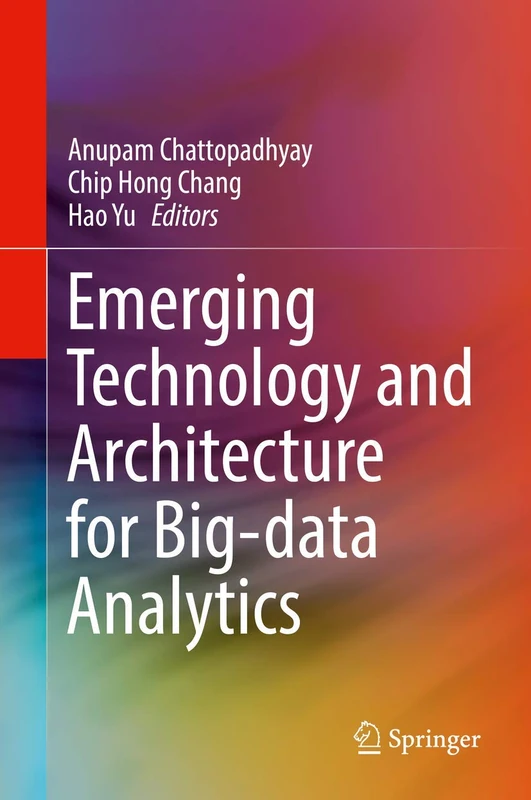
Springer Emerging Technology and Architecture for Big-data Analytics

Price data last checked 122 day(s) ago - refreshing...

View at Amazon

We'll watch every seller, every day. One email when your price arrives.

This is the usual price. Wait for it to drop, or tell us your number.

£81 today · usual range £0–£0 · best ever £48

NEW HERE?

Amazon shows you one price. We show you all of them.

Tosheroon watches Amazon prices so you don't have to. Every product on Amazon has a price history — we make it visible. Set the price you'd actually pay, and we'll email you the second it gets there. No app, no account, one email.

WHAT'S ON THIS PAGE

↓ Price chart
when this has been cheap or pricey
↓ Forecast
where the price is heading next
↓ Statistics
all-time high & low, recent range
↑ Price alert
name your number, we'll email you

Price History & Forecast

Grey patches = out of stock. Cheaper = lower on the chart. Hover for exact prices.

Last 609 days • 609 data points (No recent data available)

Historical
Generating forecast...
£107.32 £41.97 £56.23 £70.49 £84.74 £99.00 £113.26 08 July 2024 07 December 2024 08 May 2025 07 October 2025 08 March 2026

Price Distribution

Price distribution over 609 days • 4 price ranges

Days at Price
Current Price
47 days 85 days · current 394 days 83 days 0 99 197 296 394 £48-60 £72-84 £84-95 £95-107 Days at Price

Price Analysis

Most common range: £84-95 (394 days, 64.7%)

Price range: £48 - £107

Price levels: 4 price ranges over 609 days

Description

This book describes the current state of the art in big-data analytics, from a technology and hardware architecture perspective. The presentation is designed to be accessible to a broad audience, with general knowledge of hardware design and some interest in big-data analytics. Coverage includes emerging technology and devices for data-analytics, circuit design for data-analytics, and architecture and algorithms to support data-analytics. Readers will benefit from the realistic context used by the authors, which demonstrates what works, what doesn’t work, and what are the fundamental problems, solutions, upcoming challenges and opportunities. Provides a single-source reference to hardware architectures for big-data analytics; Covers various levels of big-data analytics hardware design abstraction and flow, from device, to circuits and systems; Demonstrates how non-volatile memory (NVM) based hardware platforms can be a viable solution to existing challenges in hardware architecture for big-data analytics. From the Back Cover This book describes the current state of the art in big-data analytics, from a technology and hardware architecture perspective. The presentation is designed to be accessible to a broad audience, with general knowledge of hardware design and some interest in big-data analytics. Coverage includes emerging technology and devices for data-analytics, circuit design for data-analytics, and architecture and algorithms to support data-analytics. Readers will benefit from the realistic context used by the authors, which demonstrates what works, what doesn’t work, and what are the fundamental problems, solutions, upcoming challenges and opportunities. Provides a single-source reference to hardware architectures for big-data analytics; Covers various levels of big-data analytics hardware design abstraction and flow, from device, to circuits and systems; Demonstrates how non-volatile memory (NVM) based hardware platforms can be a viable solution to existing challenges in hardware architecture for big-data analytics. About the Author Anupam Chattopadhyay received his B.E. degree from Jadavpur University, India in 2000. He received his MSc. from ALaRI, Switzerland and PhD from RWTH Aachen in 2002 and 2008 respectively. From 2008 to 2009, he worked as a Member of Consulting Staff in CoWare R&D, Noida, India. From 2010 to 2014, he led the MPSoC Architectures Research Group in RWTH Aachen, Germany as a Junior Professor. Since September, 2014, he is appointed as an assistant Professor in SCE, NTU. During his PhD, he worked on automatic RTL generation from the architecture description language LISA, which was commercialized later by a leading EDA vendor. He developed several high-level optimizations and verification flow for embedded processors. In his doctoral thesis, he proposed a language-based modeling, exploration and implementation framework for partially re-configurable processors. Together with his doctoral students, he proposed domain-specific high-level synthesis for cryptography, high-level reliability estimation flows, generalization of classic linear algebra kernels and a novel multi-layered coarse-grained reconfigurable architecture. In these areas, he published as a (co)-author over 80 conference/ journal papers, several book-chapters and a book. Anupam served in several TPCs of top conferences, regularly reviews journal/ conference articles and presented multiple invited seminars/tutorials in prestigious venues. He is a member of ACM and a senior member of IEEE. Chang Chip Hong received his B.Eng. (Hons) from National University of Singapore in 1989, and his M.Eng. and Ph.D. from the School of Electrical and Electronic Engineering of Nanyang Technological University, Singapore in 1993 and 1998, respectively. Since 1999, he has been with the School of Electrical and Electronic Engineering, Nanyang Technological University where he is currently an As

Product Specifications

Format
hardcover
Domain
Amazon UK
Release Date
27 April 2017
Listed Since
02 February 2017

Barcode

No barcode data available