£40.26

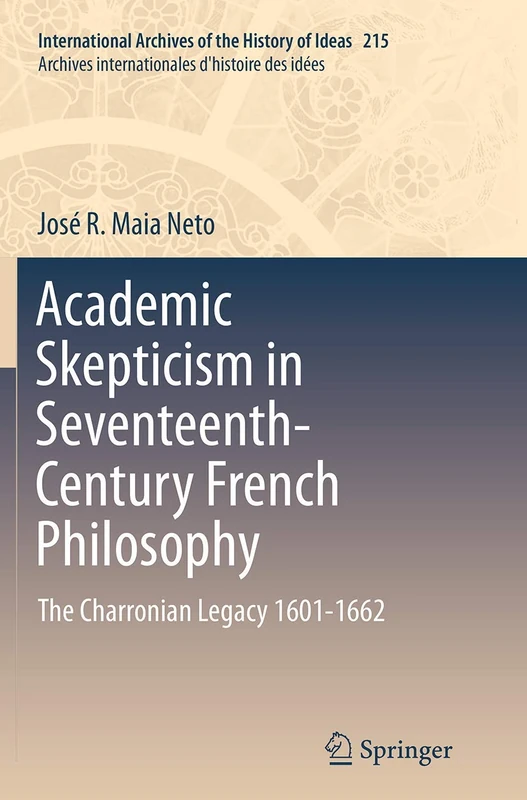
Springer Academic Skepticism in Seventeenth-Century French Philosophy: The Charronian Legacy 1601-1662: 215 (International Archives of the History of Ideas Archives internationales d'histoire des idées, 215)

Price data last checked 9 day(s) ago - will refresh soon

View at Amazon

We'll watch every seller, every day. One email when your price arrives.

About as cheap as it gets. The only time it was cheaper was 2 months ago.

£40 today · all-time low £40 (May 2026) · usually £40

NEW HERE?

Amazon shows you one price. We show you all of them.

Tosheroon watches Amazon prices so you don't have to. Every product on Amazon has a price history — we make it visible. Set the price you'd actually pay, and we'll email you the second it gets there. No app, no account, one email.

WHAT'S ON THIS PAGE

↓ Price chart
when this has been cheap or pricey
↓ Forecast
where the price is heading next
↓ Statistics
all-time high & low, recent range
↑ Price alert
name your number, we'll email you

Price History & Forecast

Grey patches = out of stock. Cheaper = lower on the chart. Hover for exact prices.

Last 82 days · 82 data points (no recent data)

Historical
Generating forecast…
£41.08 £39.65 £39.96 £40.27 £40.59 £40.90 £41.21 26 April 2026 16 May 2026 05 June 2026 25 June 2026 16 July 2026

Price Distribution

Price distribution over 82 days • 2 price levels

Days at Price
Current Price
74 days · current 8 days 0 19 37 56 74 £40 £41 Days at Price

Price Analysis

Most common price: £40 (74 days, 90.2%)

Price range: £40 - £41

Price levels: 2 different prices over 82 days

Description

This book is the first systematic account of Pierre Charron’s influence among the major French philosophers in the period (1601-1662). It shows that Charron’s Wisdom was one of the main sources of inspiration of Pierre Gassendi’s first published book, the Exercitationes adversus aristoteleos. It sheds new light on La Mothe Le Vayer, who is usually viewed as a major free thinker. By showing that he was a follower of Charron, La Mothe emerges neither as a skeptical apologist nor as a disguised libertine, as combatting superstition but not as irreligious. The book shows the close presence of Charron in the preambles of Descartes’ philosophy and that the cogito is mainly based on the moral Academic self-assurance of Charron’s wise man. This interpretation reverses the standard view of Descartes’ relation to skepticism. Once this skepticism is recognized to be Charron’s Academic one, it is seen not as the target but as the source of the cogito. Pascal is the last major philosopher for whom Charron’s wisdom is crucially relevant. Montaigne and Descartes influenced, respectively, Pascal’s view of the Pyrrhonian skeptic and of the skeptical main arguments. The book shows that Charron’s Academic skeptical wise man is one of the main targets of his projected apology for Christianity, since he considered him as a threat and counter-example of the kind of Christian view of human beings he believed. By restoring the historical philosophical relevance of Charron in early modern philosophy and arguing for the relevance of Academic skepticism in the period, this book opens a new research program to early modern scholars and will be valuable for those interested in the history of philosophy, French literature and religion. Review “It was refreshing to read a history of the development of philosophy in the first half of the seventeenth century that focused on topics that are important to everyone―wisdom, humility, freedom―and not merely interesting to professional philosophers. … Many readers, not just specialists in the history of skepticism, will derive much benefit and enjoyment from reading Maia Neto’s work.” (Michael W. Hickson, International Journal for the Study of Skepticism, Vol. 08 (2), 2018) “In recent scholarship, this is the first effort at a more systematic consideration of aspects of Charron’s influence. … The work offers many interesting textual comparisons and interpretative hypotheses in a concise way, well-informed by recent scholarship. It provides good support for the more general claim that Academic skepticism … .” (Luiz Eva, Journal of the History of Philosophy, Vol. 55 (1), January, 2017) From the Back Cover This book is the first systematic account of Pierre Charron’s influence among the major French philosophers in the period (1601-1662). It shows that Charron’s Wisdom was one of the main sources of inspiration of Pierre Gassendi’s first published book, the Exercitationes adversus aristoteleos. It sheds new light on La Mothe Le Vayer, who is usually viewed as a major free thinker. By showing that he was a follower of Charron, La Mothe emerges neither as a skeptical apologist nor as a disguised libertine, as combatting superstition but not as irreligious. The book shows the close presence of Charron in the preambles of Descartes’ philosophy and that the cogito is mainly based on the moral Academic self-assurance of Charron’s wise man. This interpretation reverses the standard view of Descartes’ relation to skepticism. Once this skepticism is recognized to be Charron’s Academic one, it is seen not as the target but as the source of the cogito. Pascal is the last major philosopher for whom Charron’s wisdom is crucially relevant. Montaigne and Descartes influenced, respectively, Pascal’s view of the Pyrrhonian skeptic and of the skeptical main arguments. The book shows that Charron’s Academic skeptical wise man is one of the main targets of his projected apology for C

Product Specifications

Format
paperback
Domain
Amazon UK
Release Date
17 September 2016
Listed Since
15 September 2016

Barcode

No barcode data available

Similar Products You Might Like