£76.41

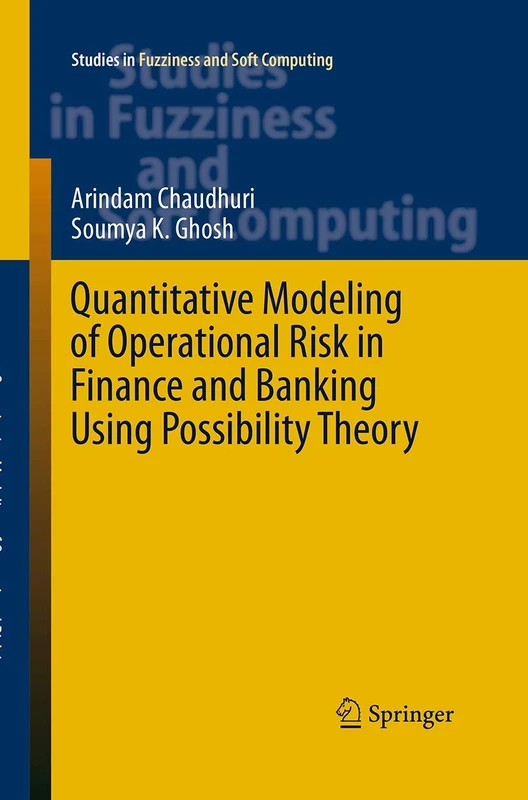
Springer Quantitative Modeling of Operational Risk in Finance and Banking Using Possibility Theory: 331 (Studies in Fuzziness and Soft Computing, 331)

Price data last checked 9 day(s) ago - will refresh soon

View at Amazon

We'll watch every seller, every day. One email when your price arrives.

This is the most expensive it has ever been. Walk away.

£76 today · previous high £76 · all-time low £76

NEW HERE?

Amazon shows you one price. We show you all of them.

Tosheroon watches Amazon prices so you don't have to. Every product on Amazon has a price history — we make it visible. Set the price you'd actually pay, and we'll email you the second it gets there. No app, no account, one email.

WHAT'S ON THIS PAGE

↓ Price chart
when this has been cheap or pricey
↓ Forecast
where the price is heading next
↓ Statistics
all-time high & low, recent range
↑ Price alert
name your number, we'll email you

Price History & Forecast

Grey patches = out of stock. Cheaper = lower on the chart. Hover for exact prices.

Last 82 days · 82 data points (no recent data)

Historical
Generating forecast…
£76.41 £75.98 £76.07 £76.17 £76.26 £76.36 £76.45 26 April 2026 16 May 2026 05 June 2026 25 June 2026 16 July 2026

Price Distribution

Price distribution over 82 days • 1 price levels

Days at Price
82 days 0 21 41 62 82 £76 Days at Price

Price Analysis

Most common price: £76 (82 days, 100.0%)

Price range: £76 - £76

Price levels: 1 different prices over 82 days

Description

This book offers a comprehensive guide to the modelling of operational risk using possibility theory. It provides a set of methods for measuring operational risks under a certain degree of vagueness and impreciseness, as encountered in real-life data. It shows how possibility theory and indeterminate uncertainty-encompassing degrees of belief can be applied in analysing the risk function, and describes the parametric g-and-h distribution associated with extreme value theory as an interesting candidate in this regard. The book offers a complete assessment of fuzzy methods for determining both value at risk (VaR) and subjective value at risk (SVaR), together with a stability estimation of VaR and SVaR. Based on the simulation studies and case studies reported on here, the possibilistic quantification of risk performs consistently better than the probabilistic model. Risk is evaluated by integrating two fuzzy techniques: the fuzzy analytic hierarchy process and the fuzzy extension of techniques for order preference by similarity to the ideal solution. Because of its specialized content, it is primarily intended for postgraduates and researchers with a basic knowledge of algebra and calculus, and can be used as reference guide for research-level courses on fuzzy sets, possibility theory and mathematical finance. The book also offers a useful source of information for banking and finance professionals investigating different risk-related aspects. From the Back Cover This book offers a comprehensive guide to the modelling of operational risk using possibility theory. It provides a set of methods for measuring operational risks under a certain degree of vagueness and impreciseness, as encountered in real-life data. It shows how possibility theory and indeterminate uncertainty-encompassing degrees of belief can be applied in analysing the risk function, and describes the parametric g-and-h distribution associated with extreme value theory as an interesting candidate in this regard. The book offers a complete assessment of fuzzy methods for determining both value at risk (VaR) and subjective value at risk (SVaR), together with a stability estimation of VaR and SVaR. Based on the simulation studies and case studies reported on here, the possibilistic quantification of risk performs consistently better than the probabilistic model. Risk is evaluated by integrating two fuzzy techniques: the fuzzy analytic hierarchy process and the fuzzy extension of techniques for order preference by similarity to the ideal solution. Because of its specialized content, it is primarily intended for postgraduates and researchers with a basic knowledge of algebra and calculus, and can be used as reference guide for research-level courses on fuzzy sets, possibility theory and mathematical finance. The book also offers a useful source of information for banking and finance professionals investigating different risk-related aspects.

Product Specifications

Format
paperback
Domain
Amazon UK
Release Date
23 August 2016
Listed Since
14 May 2016

Barcode

No barcode data available