£97.00

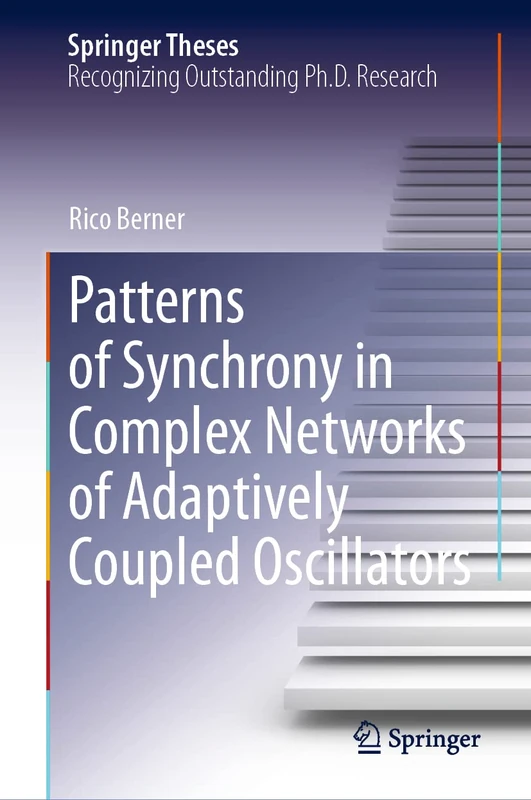
Springer Patterns of Synchrony in Complex Networks of Adaptively Coupled Oscillators (Springer Theses)

Price data last checked 10 day(s) ago - will refresh soon

View at Amazon

We'll watch every seller, every day. One email when your price arrives.

It has never been this cheap. We have no record of a lower price.

£97 today · cheaper than every other day in the last 3 months

NEW HERE?

Amazon shows you one price. We show you all of them.

Tosheroon watches Amazon prices so you don't have to. Every product on Amazon has a price history — we make it visible. Set the price you'd actually pay, and we'll email you the second it gets there. No app, no account, one email.

WHAT'S ON THIS PAGE

↓ Price chart
when this has been cheap or pricey
↓ Forecast
where the price is heading next
↓ Statistics
all-time high & low, recent range
↑ Price alert
name your number, we'll email you

Price History & Forecast

Grey patches = out of stock. Cheaper = lower on the chart. Hover for exact prices.

Last 81 days · 81 data points (no recent data)

Historical
Generating forecast…
£114.66 £95.23 £99.47 £103.71 £107.95 £112.19 £116.43 26 April 2026 16 May 2026 05 June 2026 25 June 2026 15 July 2026

Price Distribution

Price distribution over 81 days • 2 price levels

Days at Price
Current Price
74 days · current 7 days 0 19 37 56 74 £97 £115 Days at Price

Price Analysis

Most common price: £97 (74 days, 91.4%)

Price range: £97 - £115

Price levels: 2 different prices over 81 days

Description

The focus of this thesis is the interplay of synchrony and adaptivity in complex networks. Synchronization is a ubiquitous phenomenon observed in different contexts in physics, chemistry, biology, neuroscience, medicine, socioeconomic systems, and engineering. Most prominently, synchronization takes place in the brain, where it is associated with cognitive capacities like learning and memory, but is also a characteristic of neurological diseases like Parkinson and epilepsy. Adaptivity is common in many networks in nature and technology, where the connectivity changes in time, i.e., the strength of the coupling is continuously adjusted depending upon the dynamic state of the system, for instance synaptic neuronal plasticity in the brain. This research contributes to a fundamental understanding of various synchronization patterns, including hierarchical multifrequency clusters, chimeras and other partial synchronization states. After a concise survey of the fundamentals of adaptive and complex dynamical networks and synaptic plasticity, in the first part of the thesis the existence and stability of cluster synchronization in globally coupled adaptive networks is discussed for simple paradigmatic phase oscillators as well as for a more realistic neuronal oscillator model with spike-timing dependent plasticity. In the second part of the thesis the interplay of adaptivity and connectivity is investigated for more complex network structures like nonlocally coupled rings, random networks, and multilayer systems. Besides presenting a plethora of novel, sometimes intriguing patterns of synchrony, the thesis makes a number of pioneering methodological advances, where rigorous mathematical proofs are given in the Appendices. These results are of interest not only from a fundamental point of view, but also with respect to challenging applications in neuroscience and technological systems. From the Back Cover The focus of this thesis is the interplay of synchrony and adaptivity in complex networks. Synchronization is a ubiquitous phenomenon observed in different contexts in physics, chemistry, biology, neuroscience, medicine, socioeconomic systems, and engineering. Most prominently, synchronization takes place in the brain, where it is associated with cognitive capacities like learning and memory, but is also a characteristic of neurological diseases like Parkinson and epilepsy. Adaptivity is common in many networks in nature and technology, where the connectivity changes in time, i.e., the strength of the coupling is continuously adjusted depending upon the dynamic state of the system, for instance synaptic neuronal plasticity in the brain. This research contributes to a fundamental understanding of various synchronization patterns, including hierarchical multifrequency clusters, chimeras and other partial synchronization states. After a concise survey of the fundamentals of adaptive and complex dynamical networks and synaptic plasticity, in the first part of the thesis the existence and stability of cluster synchronization in globally coupled adaptive networks is discussed for simple paradigmatic phase oscillators as well as for a more realistic neuronal oscillator model with spike-timing dependent plasticity. In the second part of the thesis the interplay of adaptivity and connectivity is investigated for more complex network structures like nonlocally coupled rings, random networks, and multilayer systems. Besides presenting a plethora of novel, sometimes intriguing patterns of synchrony, the thesis makes a number of pioneering methodological advances, where rigorous mathematical proofs are given in the Appendices. These results are of interest not only from a fundamental point of view, but also with respect to challenging applications in neuroscience and technological systems. About the Author Rico Berner is a mathematician and physicist. In his research he combines ideas and technique

Product Specifications

Format
hardcover
Domain
Amazon UK
Release Date
01 June 2021
Listed Since
25 March 2021

Barcode

No barcode data available