£62.90

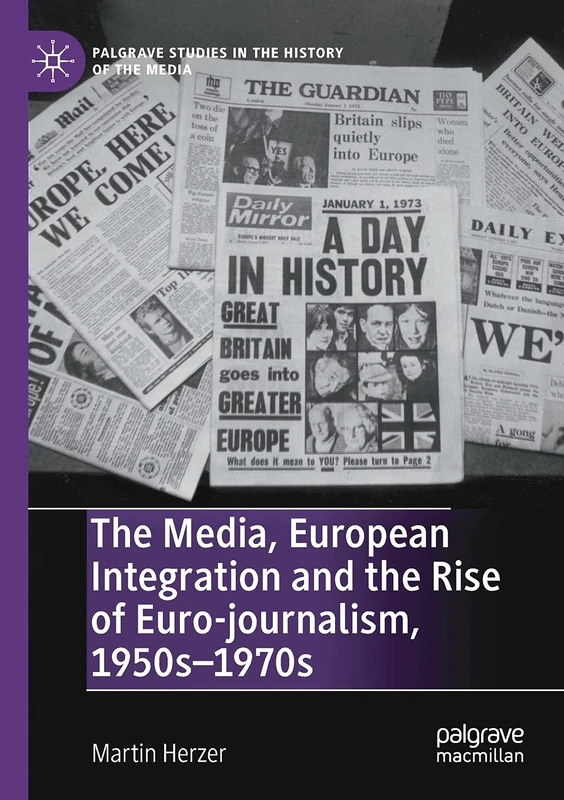
MACMILLAN The Media, European Integration and the Rise of Euro-journalism, 1950s–1970s (Palgrave Studies in the History of the Media)

Price data checked 1 day ago

View at Amazon

We'll watch every seller, every day. One email when your price arrives.

It has never been this cheap. We have no record of a lower price.

£63 today · cheaper than every other day in the last 3 months

NEW HERE?

Amazon shows you one price. We show you all of them.

Tosheroon watches Amazon prices so you don't have to. Every product on Amazon has a price history — we make it visible. Set the price you'd actually pay, and we'll email you the second it gets there. No app, no account, one email.

WHAT'S ON THIS PAGE

↓ Price chart
when this has been cheap or pricey
↓ Forecast
where the price is heading next
↓ Statistics
all-time high & low, recent range
↑ Price alert
name your number, we'll email you

Price History & Forecast

Grey patches = out of stock. Cheaper = lower on the chart. Hover for exact prices.

Last 90 days · 90 data points

Historical
Generating forecast…
£62.90 £59.75 £61.01 £62.27 £63.53 £64.79 £66.05 14 April 2026 06 May 2026 28 May 2026 19 June 2026 12 July 2026

Price Distribution

Price distribution over 90 days • 1 price levels

Days at Price
90 days 0 23 45 68 90 £63 Days at Price

Price Analysis

Most common price: £63 (90 days, 100.0%)

Price range: £63 - £63

Price levels: 1 different prices over 90 days

Description

This book explains how the media helped to invent the European Union as the supranational polity that we know today. Against normative EU scholarship, it tells the story of the rise of the Euro-journalists – pro-European advocacy journalists – within the post-war Western European media. The Euro-journalists pioneered a journalism which symbolically magnified the technocratic European Community as the embodiment of Europe. Normative research on the media and European integration has focused on how the media might help to construct a democratic and legitimate European Union. In contrast, this book aims to deconstruct how journalists – as part of Western European elites – played a key role in elite European identity building campaigns. Review “It provides a rich and detailed insight into European journalism history against the background of European integration history while also adding to our understanding of present day EU–media relations. … Herzer’s book is a time travel companion well recommended.” (Carolin Rüger, JCMS Journal of Common Market Studies, August 28, 2020) Review “An important new contribution to the (still under-researched) symbolic politics of the European project, Herzer’s book offers a much-needed portrait of the rise of Euro-journalists. Through a unique multi-archival and fine-grained analysis, Herzer unveils their critical role in restaging the European Union from a mere economic endeavor to a grand project of political integration. A must-read for anyone interested in the perennial debate over Europe’s public sphere.” (Antoine Vauchez, Université Paris 1-Sorbonne, France) “An important contribution to the history and sociology of the ‘European public sphere’, and a long overdue account of the role of the media in the rise of supranational neoliberalism over alternative modes of European cooperation.” (Wolfgang Streeck, Max Planck Institute for the Study of Societies, Germany) “Thoroughly researched and incisive, Herzer’s book convincingly breaks with much of the conventional wisdom on the « permissive consensus » of the early years of the European communities and the lack of a European public sphere. He masterfully demonstrates how advocacy journalists, embedded into elite networks in Brussels and national polities, made a decisive contribution to the recognition and legitimation of the EEC/EC as the incarnation of Europe.” (Jay Rowell, University of Strasbourg, France) “This insightful and convincing study, based on research conducted in various archives in four countries as well as interviews with numerous journalists, challenges normative EU scholarship, which has focused on the instrumentalization of the media to build a democratic and legitimate European Union. Instead, Herzer shows how during the postwar decades, the Western European media became partisans of an – ultimately ineffective – elite effort to sell supranational European integration to national publics. This book constitutes a major contribution to both European integration history and media history.” (Peter Hoeres, Julius-Maximilians-University, Germany)         From the Back Cover This book explains how the media helped to invent the European Union as the supranational polity that we know today. Against conventional EU scholarship, it tells the story of the rise of the Euro-journalists – pro-European advocacy journalists – within the post-war Western European media, and argues that the Euro-journalists pioneered a shift in the media representation of European integration. During the 1950s, multiple visions of Western European cooperation competed in the media, which initially considered the European Community to be a merely technocratic international organization. By the late 1970s, however, the media were symbolically magnifying the Community as a sui generis European polity and the sole embodiment of Europe. Normative research on the media and European integration has fo

Product Specifications

Format
paperback
Domain
Amazon UK
Release Date
26 August 2021
Listed Since
06 December 2020

Barcode

No barcode data available

Similar Products You Might Like