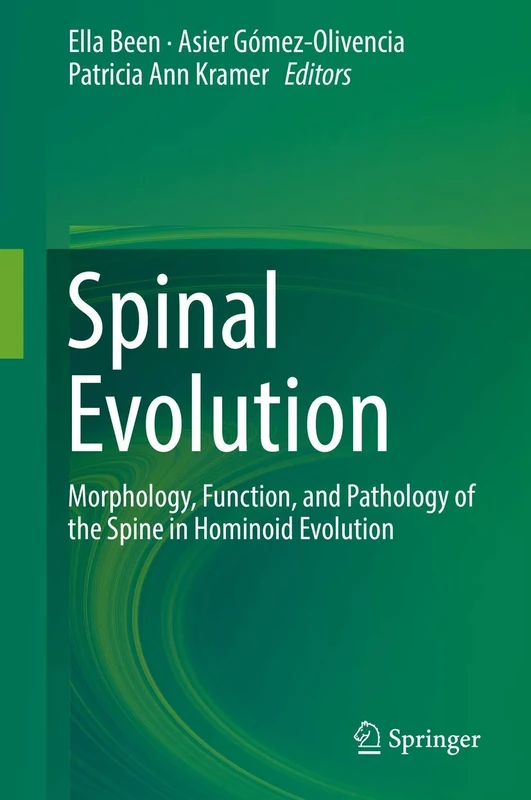
The vertebral spine is a key element of the human anatomy. Its main role is to protect the spinal cord and the main blood vessels. The axial skeleton, with its muscles and joints, provides stability for the attachment of the head, tail and limbs and, at the same time, enables the mobility required for breathing and for locomotion. Despite its great importance, the vertebral spine is often over looked by researchers because: a) vertebrae are fragile in nature, which makes their fossilization a rare event; b) they are metameric (seriated and repeated elements) that make their anatomical determination and, thus, their subsequent study difficult; and c) the plethora of bones and joints involved in every movement or function of the axial skeleton makes the reconstruction of posture, breathing mechanics and locomotion extremely difficult. It is well established that the spine has changed dramatically during human evolution. Spinal curvatures, spinal load transmission, and thoracic shape of bipedal humans are derived among hominoids. Yet, there are many debates as to how and when these changes occurred and to their phylogenetic, functional, and pathological implications. In recent years, renewed interest arose in the axial skeleton. New and exciting finds, mostly from Europe and Africa, as well as new methods for reconstructing the spine, have been introduced to the research community. New methodologies such as Finite Element Analysis, trabecular bone analysis, Geometric Morphometric analysis, and gait analysis have been applied to the spines of primates and humans. These provide a new and refreshing look into the evolution of the spine. Advanced biomechanical research regarding posture, range of motion, stability, and attenuation of the human spine has interesting evolutionary implications. Until now, no book that summarizes the updated research and knowledge regarding spinal evolution in hominoids has been available. The present book explores both these new methodologies and new data, including recent fossil, morphological, biomechanical, and theoretical advances regarding vertebral column evolution. In order to cover all of that data, we divide the book into four parts: 1) the spine of hominoids; 2) the vertebral spine of extinct hominins; 3) ontogeny, biomechanics and pathology of the human spine; and 4) new methodologies of spinal research. These parts complement each other and provide a wide and comprehensive examination of spinal evolution. From the Back Cover The vertebral spine is a key element of the human anatomy. Its main role is to protect the spinal cord and the main blood vessels. The axial skeleton, with its muscles and joints, provides stability for the attachment of the head, tail and limbs and, at the same time, enables the mobility required for breathing and for locomotion. Despite its great importance, the vertebral spine is often over looked by researchers because: a) vertebrae are fragile in nature, which makes their fossilization a rare event; b) they are metameric (seriated and repeated elements) that make their anatomical determination and, thus, their subsequent study difficult; and c) the plethora of bones and joints involved in every movement or function of the axial skeleton makes the reconstruction of posture, breathing mechanics and locomotion extremely difficult. It is well established that the spine has changed dramatically during human evolution. Spinal curvatures, spinal load transmission, and thoracic shape of bipedal humans are derived among hominoids. Yet, there are many debates as to how and when these changes occurred and to their phylogenetic, functional, and pathological implications. In recent years, renewed interest arose in the axial skeleton. New and exciting finds, mostly from Europe and Africa, as well as new methods for reconstructing the spine, have been introduced to the research community. New methodologies such as Finite Element Analysis,