£83.21

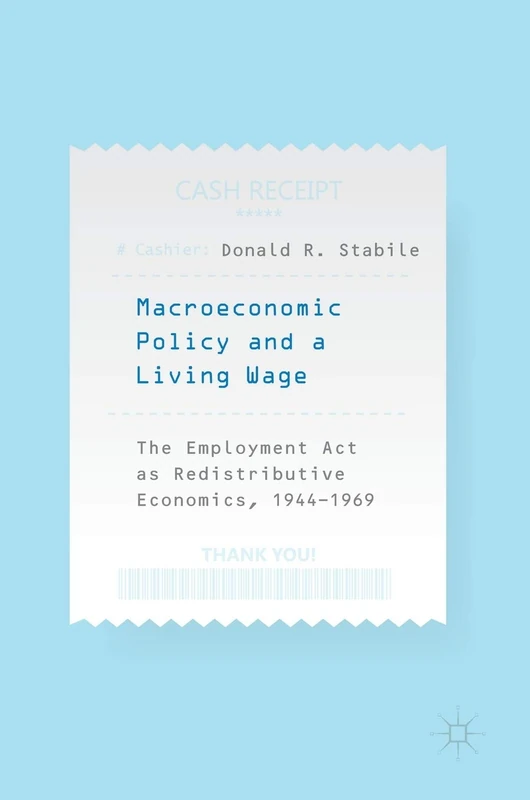
MACMILLAN Macroeconomic Policy and a Living Wage: The Employment Act as Redistributive Economics, 1944–1969

Price data last checked 11 day(s) ago - will refresh soon

View at Amazon

We'll watch every seller, every day. One email when your price arrives.

About as cheap as it gets. The only time it was cheaper was 2 months ago.

£83 today · all-time low £81 (Apr 2026) · usually £84

NEW HERE?

Amazon shows you one price. We show you all of them.

Tosheroon watches Amazon prices so you don't have to. Every product on Amazon has a price history — we make it visible. Set the price you'd actually pay, and we'll email you the second it gets there. No app, no account, one email.

WHAT'S ON THIS PAGE

↓ Price chart
when this has been cheap or pricey
↓ Forecast
where the price is heading next
↓ Statistics
all-time high & low, recent range
↑ Price alert
name your number, we'll email you

Price History & Forecast

Grey patches = out of stock. Cheaper = lower on the chart. Hover for exact prices.

Last 80 days · 80 data points (no recent data)

Historical
Generating forecast…
£84.28 £80.83 £81.58 £82.33 £83.09 £83.84 £84.59 26 April 2026 15 May 2026 04 June 2026 24 June 2026 14 July 2026

Price Distribution

Price distribution over 80 days • 3 price levels

Days at Price
Current Price
4 days 26 days · current 50 days 0 13 25 38 50 £81 £83 £84 Days at Price

Price Analysis

Most common price: £84 (50 days, 62.5%)

Price range: £81 - £84

Price levels: 3 different prices over 80 days

Description

This book offers a new interpretation of the Employment Act of 1946.  It argues that in addition to Keynesian economics, the idea of a living wage was also part of the background leading up to the Employment Act.  The Act mandated that the president prepare an Economic Report on the state of the economy and how to improve it, and the idea of a living wage was an essential issue in those Economic Reports for over two decades. The author argues that macroeconomic policy in the USA consisted of a dual approach of using a living wage to increase consumption with higher wages, and fiscal policy to create jobs and higher levels of consumption, therefore forming a hybrid system of redistributive economics. An important read for scholars of economic history, this book explores Roosevelt’s role in the debates over the Employment Act in the 1940s, and underlines how Truman’s Fair Deal, Kennedy’s New Frontier and Johnson’s Great Society all had the ultimate goal of a living wage, despite their variations of its definition and name. From the Back Cover   “Donald Stabile provides a fascinating history of the economic and political debates leading up to, and following, the Employment Act of 1946. Contrary to common understanding, Stabile argues that there were strong tensions between New Dealers and Keynesians, including around their vision of the purpose of minimum wages, and of unions and collective bargaining. This book is a must-read for economists, as well as policy-makers and activists, looking for new economic models which provide jobs and living wages.” ―Stephanie Luce, Professor and Department Chair, School for Labor and Urban Studies, Department of Sociology, The Graduate Center, CUNY, USA This book offers a new interpretation of the Employment Act of 1946.  It argues that in addition to Keynesian economics, the idea of a living wage was also part of the background leading up to the Employment Act.  The Act mandated that the president prepare an Economic Report on the state of the economy and how to improve it, and the idea of a living wage was an essential issue in those Economic Reports for over two decades. The author argues that macroeconomic policy in the USA consisted of a dual approach of using a living wage to increase consumption with higher wages, and fiscal policy to create jobs and higher levels of consumption, therefore forming a hybrid system of redistributive economics. An important read for scholars of economic history, this book explores Roosevelt’s role in the debates over the Employment Act in the 1940s, and underlines how Truman’s Fair Deal, Kennedy’s New Frontier and Johnson’s Great Society all had the ultimate goal of a living wage, despite their variations of its definition and name. About the Author Donald R. Stabile is Professor of Economics at St. Mary's College of Maryland, USA, where he has taught for nearly 40 years. He is the author or co-author of 12 previous books, including The Political Economy of a Living Wage (2016), and scholarly articles on the history of political economy.

Product Specifications

Format
hardcover
Domain
Amazon UK
Release Date
12 November 2018
Listed Since
31 August 2018

Barcode

No barcode data available