£75.84

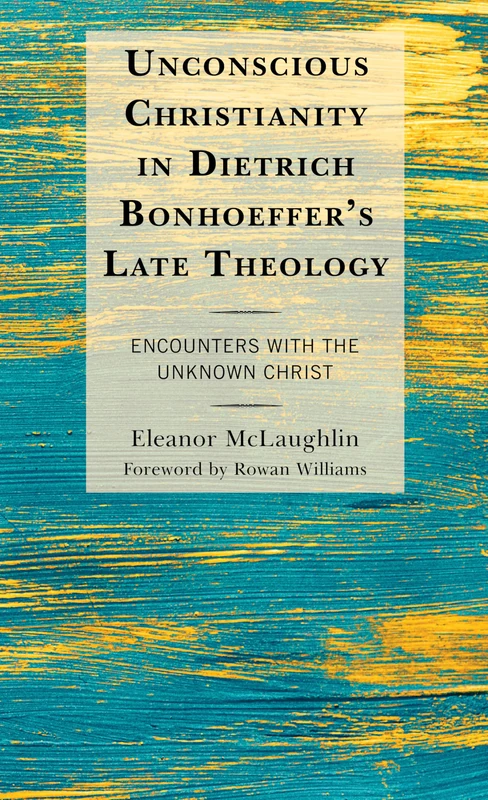
Lexington Books Unconscious Christianity in Dietrich Bonhoeffer's Late Theology: Encounters with the Unknown Christ

Price data last checked 90 day(s) ago - refreshing...

View at Amazon

We'll watch every seller, every day. One email when your price arrives.

It has never been this cheap. We have no record of a lower price.

£76 today · cheaper than every other day in the last 3 months

NEW HERE?

Amazon shows you one price. We show you all of them.

Tosheroon watches Amazon prices so you don't have to. Every product on Amazon has a price history — we make it visible. Set the price you'd actually pay, and we'll email you the second it gets there. No app, no account, one email.

WHAT'S ON THIS PAGE

↓ Price chart
when this has been cheap or pricey
↓ Forecast
where the price is heading next
↓ Statistics
all-time high & low, recent range
↑ Price alert
name your number, we'll email you

Price History & Forecast

Grey patches = out of stock. Cheaper = lower on the chart. Hover for exact prices.

Last 1 days · 1 data points (no recent data)

Historical
Generating forecast…
Not enough data points to display chart (need at least 2 points)

Price Distribution

Price distribution over 1 days • 1 price levels

Days at Price
1 day 0 0 1 1 1 £76 Days at Price

Price Analysis

Most common price: £76 (1 days, 100.0%)

Price range: £76 - £76

Price levels: 1 different prices over 1 days

Description

In the last years of his life, Dietrich Bonhoeffer began work on an idea that he called unbewußtes Christentum, "unconscious Christianity." While Bonhoeffer's other ideas from this period have been extensively studied and are important in the field of theology and beyond, this idea has been almost completely ignored. For the first time in Bonhoeffer scholarship, Eleanor McLaughlin provides a definition of unconscious Christianity, based on a close reading and analysis of the texts in which Bonhoeffer mentioned the term. From a variety of surviving texts, from a scribbled marginal note in his Ethics manuscript to the fiction he wrote in prison, she constructs a detailed definition of unconscious Christianity that sheds light not only on Bonhoeffer's late work but his theological development as a whole. Review While there has been much ink spilled over Bonhoeffer's religionless Christianity and over Rahner's anonymous Christianity, there has been surprisingly little reflection on Bonhoeffer's account of unconscious Christianity. With thoroughness, care, and precision, Eleanor McLaughlin has done not only Bonhoeffer studies but also theology a great service in unpacking this important theme for the contemporary world. This is a remarkable achievement.--Tom Greggs, FRSE, Marischal Chair (1616) and Head of Divinity, University of AberdeenBonhoeffer scholars and all theologians interested in the church's relationship to post-Christian secular culture will find in McLaughlin's study much food for thought.-- "Studies in Christian Ethics"Bonhoeffer used the phrase "unconscious Christianity" four times. The first time was in the margin of his Ethics essay, "Ultimate and Penultimate Things." From Tegel Prison he began to develop the idea through works of fiction. Bonhoeffer then used the term in a letter to his friend Eberhard Bethge, and it appears in two notes for a potential book, found in Letters and Papers from Prison (1953). McLaughlin carefully studies these texts and puts them in the context of Bonhoeffer's life and developing theology. She sees this concept as opening up "new ways in which Bonhoeffer's theology can be used by the Church to make sense of its present situation" (p. 2). Basically, she argues that it is possible for people to be Christians while not identifying themselves as Christians. They act compassionately to those in need and are thereby engaging with Jesus Christ. Since it is through love that "God acts through us" (p. 159, quoting Bonhoeffer), and Jesus was the one who was "for others," as persons engage in selfless acts of love, they are identifying with Jesus--even unconsciously. Their participation in Jesus, to whom the world belongs, is "no longer the exclusive action of conscious Christians; unconscious Christians are capable of it as well" (p. 163). Summing Up: Recommended. Graduate students, researchers, faculty.-- "Choice"With this first book length treatment of unconscious Christianity, Eleanor McLaughlin offers a carefully researched, compelling, and pathbreaking interpretation of what is perhaps Bonhoeffer's most challenging theological legacy. Her careful reading not only clarifies what Bonhoeffer meant by unconscious Christianity, but also opens up new directions for Bonhoeffer research, and for all concerned about the church's witness in a secular age.--Jens Zimmermann, Trinity Western University About the Author Eleanor McLaughlin is lecturer in theology and ethics at Regent’s Park College, University of Oxford, and research associate at the Oxford Centre for Religion and Culture.

Product Specifications

Format
hardcover
Domain
Amazon UK
Release Date
27 May 2020
Listed Since
23 November 2019

Barcode

No barcode data available