£43.99

Packt Publishing Bayesian Analysis with Python

Price data last checked 20 day(s) ago - will refresh soon

View at Amazon

We'll watch every seller, every day. One email when your price arrives.

This is the most expensive it has ever been. Walk away.

£44 today · previous high £44 · all-time low £42

NEW HERE?

Amazon shows you one price. We show you all of them.

Tosheroon watches Amazon prices so you don't have to. Every product on Amazon has a price history — we make it visible. Set the price you'd actually pay, and we'll email you the second it gets there. No app, no account, one email.

WHAT'S ON THIS PAGE

↓ Price chart
when this has been cheap or pricey
↓ Forecast
where the price is heading next
↓ Statistics
all-time high & low, recent range
↑ Price alert
name your number, we'll email you

Price History & Forecast

Grey patches = out of stock. Cheaper = lower on the chart. Hover for exact prices.

Last 71 days · 71 data points (no recent data)

Historical
Generating forecast…
£43.99 £41.79 £42.27 £42.75 £43.23 £43.71 £44.19 25 April 2026 12 May 2026 30 May 2026 16 June 2026 04 July 2026

Price Distribution

Price distribution over 71 days • 2 price levels

Days at Price
Current Price
8 days 63 days · current 0 16 32 47 63 £42 £44 Days at Price

Price Analysis

Most common price: £44 (63 days, 88.7%)

Price range: £42 - £44

Price levels: 2 different prices over 71 days

Description

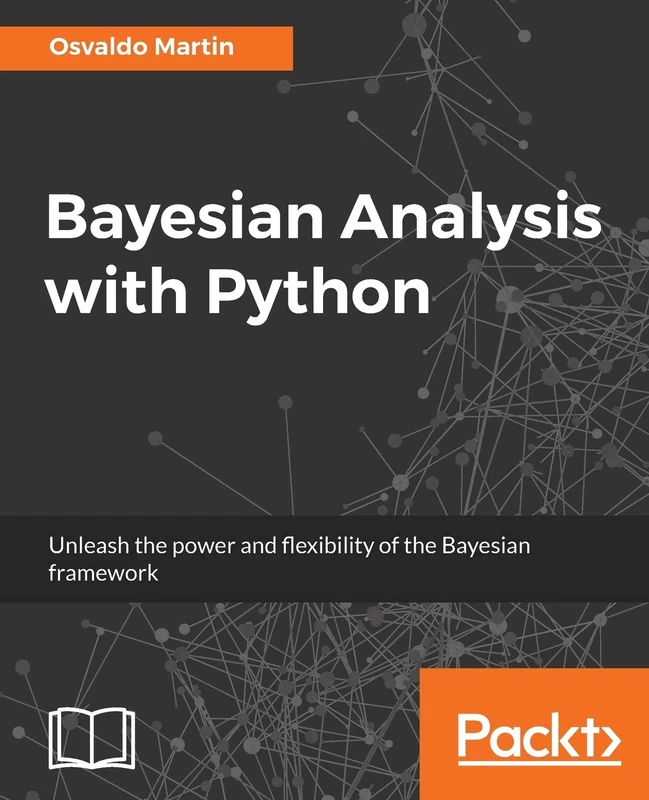
Key Features Simplify the Bayes process for solving complex statistical problems using Python; Tutorial guide that will take the you through the journey of Bayesian analysis with the help of sample problems and practice exercises; Learn how and when to use Bayesian analysis in your applications with this guide. Book Description The purpose of this book is to teach the main concepts of Bayesian data analysis. We will learn how to effectively use PyMC3, a Python library for probabilistic programming, to perform Bayesian parameter estimation, to check models and validate them. This book begins presenting the key concepts of the Bayesian framework and the main advantages of this approach from a practical point of view. Moving on, we will explore the power and flexibility of generalized linear models and how to adapt them to a wide array of problems, including regression and classification. We will also look into mixture models and clustering data, and we will finish with advanced topics like non-parametrics models and Gaussian processes. With the help of Python and PyMC3 you will learn to implement, check and expand Bayesian models to solve data analysis problems. What you will learn Understand the essentials Bayesian concepts from a practical point of view Learn how to build probabilistic models using the Python library PyMC3 Acquire the skills to sanity-check your models and modify them if necessary Add structure to your models and get the advantages of hierarchical models Find out how different models can be used to answer different data analysis questions When in doubt, learn to choose between alternative models. Predict continuous target outcomes using regression analysis or assign classes using logistic and softmax regression. Learn how to think probabilistically and unleash the power and flexibility of the Bayesian framework About the Author Osvaldo Martin is a researcher at The National Scientific and Technical Research Council (CONICET), the main organization in charge of the promotion of science and technology in Argentina. He has worked on structural bioinformatics and computational biology problems, especially on how to validate structural protein models. He has experience in using Markov Chain Monte Carlo methods to simulate molecules and loves to use Python to solve data analysis problems. He has taught courses about structural bioinformatics, Python programming, and, more recently, Bayesian data analysis. Python and Bayesian statistics have transformed the way he looks at science and thinks about problems in general. Osvaldo was really motivated to write this book to help others in developing probabilistic models with Python, regardless of their mathematical background. He is an active member of the PyMOL community (a C/Python-based molecular viewer), and recently he has been making small contributions to the probabilistic programming library PyMC3. Table of Contents Thinking Probabilistically - A Bayesian Inference Primer Programming Probabilistically – A PyMC3 Primer Juggling with Multi-Parametric and Hierarchical Models Understanding and Predicting Data with Linear Regression Models Classifying Outcomes with Logistic Regression Model Comparison Mixture Models Gaussian Processes

Product Specifications

Format
paperback
Domain
Amazon UK
Release Date
25 November 2016
Listed Since
23 October 2015

Barcode

No barcode data available