£259.83

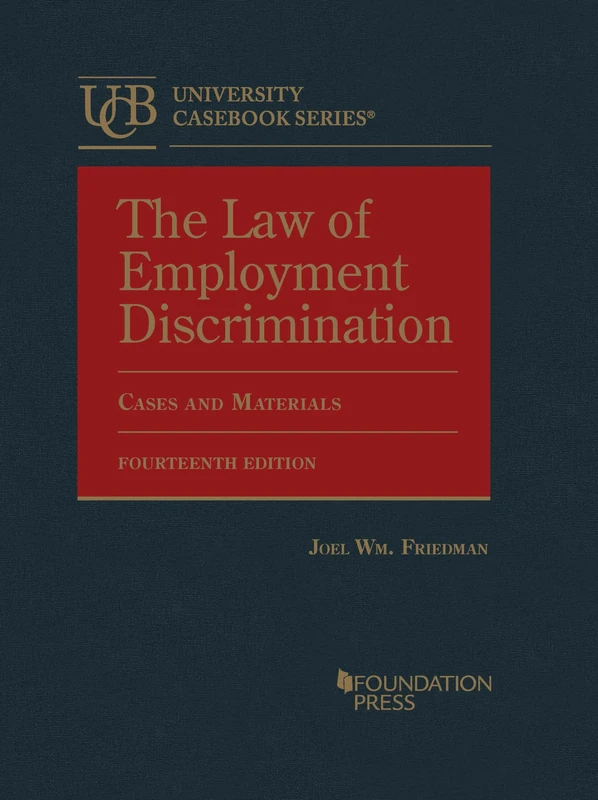
Foundation Press The Law of Employment Discrimination: Cases and Materials (University Casebook Series)

Price data last checked 14 day(s) ago - will refresh soon

View at Amazon

We'll watch every seller, every day. One email when your price arrives.

About as cheap as it gets. The only time it was cheaper was 1 month ago.

£260 today · all-time low £249 (Aug 2026) · usually £259

NEW HERE?

Amazon shows you one price. We show you all of them.

Tosheroon watches Amazon prices so you don't have to. Every product on Amazon has a price history — we make it visible. Set the price you'd actually pay, and we'll email you the second it gets there. No app, no account, one email.

WHAT'S ON THIS PAGE

↓ Price chart
when this has been cheap or pricey
↓ Forecast
where the price is heading next
↓ Statistics
all-time high & low, recent range
↑ Price alert
name your number, we'll email you

Price History & Forecast

Grey patches = out of stock. Cheaper = lower on the chart. Hover for exact prices.

Last 77 days · 77 data points (no recent data)

Historical
Generating forecast…
£266.46 £246.76 £251.06 £255.36 £259.65 £263.95 £268.25 10 June 2026 29 June 2026 18 July 2026 06 August 2026 25 August 2026

Price Distribution

Price distribution over 77 days • 5 price ranges

Days at Price
Current Price
5 days 1 day 6 days 39 days · current 26 days 0 10 20 29 39 £249-252 £252-256 £256-259 £259-263 £263-266 Days at Price

Price Analysis

Most common range: £259-263 (39 days, 50.6%)

Price range: £249 - £266

Price levels: 5 price ranges over 77 days

Description

This casebook covers all major aspects of employment discrimination law, including benchmark legislative, administrative, and judicial developments. Due in part to frequent updates and revisions, it has received accolades as one of the most comprehensive and frequently updated texts on the market. The 14th Edition continues this tradition by seamlessly incorporating all major legislative and judicial developments through July 2023, including all relevant decisions rendered by the Supreme Court in its 2022-2023 term. The major Supreme Court rulings were in Groff v. Dejoy and Students for Fair Admissions, Inc. v. President and Fellows of Harvard College. In Groff, a unanimous Court expanded an employer's duty to accommodate religious beliefs and practices under Title VII by ruling that the standard of undue hardship requires a showing that the burden is substantial in the overall context of an employer's business, including an assessment of the impact on the coworkers. Instead of having to prove only the incurring of a de minimis expense, an employer now must show the burden is excessive or unjustifiable. In Students for Fair Admissions, a non-employment case, a six-member majority ruled that the use of race in the admissions policies of the two defendants (Harvard and the University of North Carolina) violated the Equal Protection Clause of the Fourth Amendment. Applying strict scrutiny to the defendant's acknowledged use of race in their admissions processes, the Court ruled that these programs failed both the compelling interest and narrowly tailored components of strict scrutiny. There also were important circuit court opinions. In Demkovich v. St. Andrew, the en banc Seventh Circuit ruled that the ministerial exception under Title VII barred any claim against a minister regardless of whether it alleged the existence of a tangible employment action or solely a hostile environment. In Gogel v. Kia Motors, the en banc Eleventh Circuit held that §704(a) will not protect an employee who alleges retaliation for engaging in protected opposition conduct when the means by which the employee expressed that opposition so interfered with the performance of that employee's duties as to render that employee ineffective in their position. In Roberts v. Glenn, the Fourth Circuit added itself to the list of circuits construing the Supreme Court's ruling in Oncale (about "same sex" harassment cases) as allowing a plaintiff to establish the existence of proscribed sex-based discrimination by proving that the plaintiff was subjected to harassment because the plaintiff was perceived as not conforming to traditional gender stereotypes. And in Williams v. Kincaid, in a case of first impression, the Fourth Circuit concluded that a transgender individual with gender dysphoria did not fall within the ADA's exclusion of "gender identity disorders not resulting from physical impairments" from the category of covered disabilities.

Product Specifications

Format
hardcover
Domain
Amazon UK
Release Date
31 March 2024
Listed Since
07 December 2023

Barcode

No barcode data available