£92.19

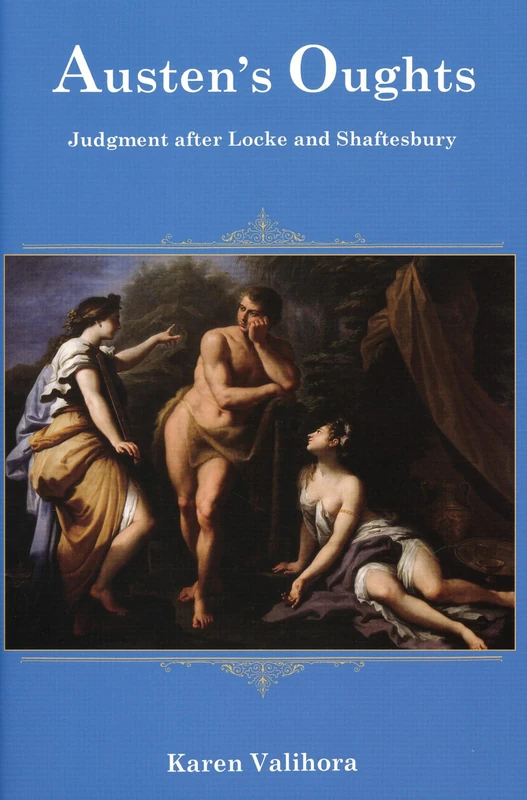
University of Delaware Press Austen's Oughts: Judgment After Locke and Shaftesbury

Price data last checked 17 day(s) ago - will refresh soon

View at Amazon

We'll watch every seller, every day. One email when your price arrives.

This is the most expensive it has ever been. Walk away.

£92 today · previous high £92 · all-time low £92

NEW HERE?

Amazon shows you one price. We show you all of them.

Tosheroon watches Amazon prices so you don't have to. Every product on Amazon has a price history — we make it visible. Set the price you'd actually pay, and we'll email you the second it gets there. No app, no account, one email.

WHAT'S ON THIS PAGE

↓ Price chart
when this has been cheap or pricey
↓ Forecast
where the price is heading next
↓ Statistics
all-time high & low, recent range
↑ Price alert
name your number, we'll email you

Price History & Forecast

Grey patches = out of stock. Cheaper = lower on the chart. Hover for exact prices.

Last 74 days · 74 data points (no recent data)

Historical
Generating forecast…
£92.19 £91.59 £91.72 £91.85 £91.98 £92.11 £92.25 27 April 2026 15 May 2026 02 June 2026 20 June 2026 09 July 2026

Price Distribution

Price distribution over 74 days • 1 price levels

Days at Price
74 days 0 19 37 56 74 £92 Days at Price

Price Analysis

Most common price: £92 (74 days, 100.0%)

Price range: £92 - £92

Price levels: 1 different prices over 74 days

Description

The word is all over Austen's novels: what ought to be done, what one ought to say, how one ought to feel (versus how one does feel). When Austen's characters employ an ought, the delicate oscillation between first- and third-person perspectives that marks her prose leads the reader to distinguish between what they say, and what they ought, according to a morally idealized, third-person calculus, to mean. But what is the context of this ought? This book situates the disinterested, reflective appeal to moral principle invoked_ironically or otherwise_in Austen's oughts within the history of thought about judgment in the British eighteenth century. Beginning with Shaftesbury's critique of Locke's account of judgment, successive readings explore the emphasis on disinterest in works by David Hume, Adam Smith, Samuel Richardson, and Sir Joshua Reynolds alongside discussions of Jane Austen's major novels. Review Karen Valihora's clever and ambitious book locates the aesthetic at the heart of an eighteenth-century moral tradition that culminates, at the end of the century, in the novels of Jane Austen. . . Austen's Oughts challenges influential interpretations of Austen as a nostalgic Christian conservative by identifying her as very much a creature of her times--that is, of the Enlightenment. ... Valihora's interests are remarkably wide-ranging. They yield a correspondingly eclectic and erudite study. ... Valihora [makes a] fine achievement in Austen's Oughts. She has written a book that manages to be at once philosophically substantive and attentive to the text, that moves back and forth between abstract theorizing and close reading in ways that parallel the trajectories of free indirect discourse and of reflective judgment itself. Valihora is a critical voice that future generations of Austen scholars will find difficult to ignore.--Eighteenth-Century Fiction Karen Valihora's thought-provoking book offers a consideration of the idea of judgement in the novels of Jane Austen and in Samuel Richardson's Clarissa, with particular reference to the works of Adam Smith, John Locke, the Earl of Shaftesbury, and - surprisingly - Joshua Reynold's Discourses on Art. This is an encouraging contribution to the studies of the long eighteenth century.--Times Literary Supplement Karen Valihora's Austen's Oughts sets out to trace the development of the aesthetic across the century from the viewpoint of its own architects, rather than following the tradition of such debunking hermeneutics. Deliberately embracing neoclassical aesthetic values, Valihora describes how the aesthetic emerged in response to particular developments within empiricism. ... The story Valihora tells is compelling.--Eighteenth-Century Life One of the dominant intellectual debates of the eighteenth century circled around the issue of determining whether there were ultimate standards, standards of taste, moral standards, and standards of proper conduct and propriety. . . In her book Austen's Oughts, Karen Valihora argues that a proper understanding of Austen's novels needs to begin with a consideration of these eighteenth-century debates. ... Valihora's most significant contribution to our understanding of Austen occurs in her chapter on Sir Joshua Reynolds, whose paintings and lectures delivered during his tenure as president of the Royal Academy served to initiate what has come to be called the picturesque tradition in art. . . . Valihora offers a book that places Austen's work solidly within the intellectual climate of the eighteenth century and demonstrates how art, and Austen's art in particular, is able to detail the difficult balance one attains when he can reconcile his personal interests and ways of seeing with a vision that is sharable and beneficial to the public good.--Jasna News Valihora (York Univ., Canada) presents a rich, readable study of the contemporaneous social, philosophical, and literary contexts of Austen's work. . . . Summing

Product Specifications

Format
hardcover
Domain
Amazon UK
Release Date
01 April 2010
Listed Since
08 November 2010

Barcode

No barcode data available