Out of Stock

This item is currently unavailable

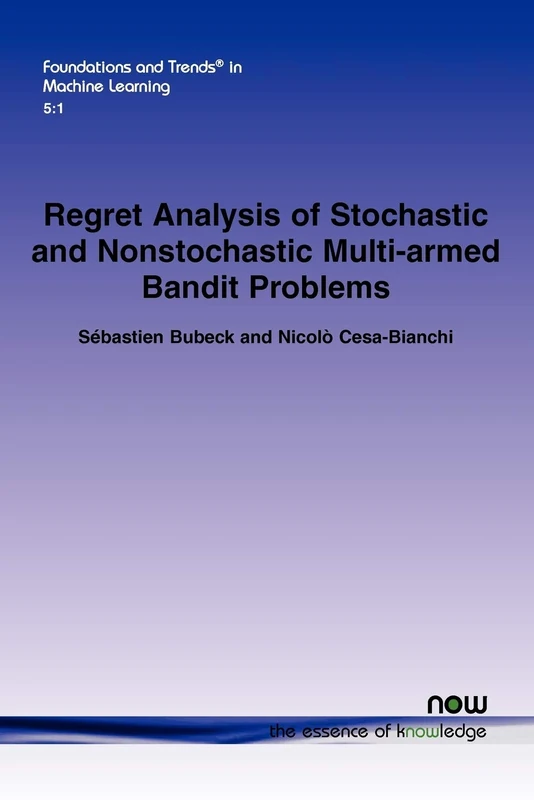
Not Avail Regret Analysis of Stochastic and Nonstochastic Multi-Armed Bandit Problems (Foundations and Trends (R) in Machine Learning)

Out of Stock

Price data last checked 80 day(s) ago - refreshing...

View at Amazon

One email. No newsletter. No nudges.

Gone for 145 days. Could come back at any time — we're watching for you.

Out of stock 145 days · last price £65 · longest previous gap was 1 days

NEW HERE?

Amazon shows you one price. We show you all of them.

Tosheroon watches Amazon prices so you don't have to. Every product on Amazon has a price history — we make it visible. Set the price you'd actually pay, and we'll email you the second it gets there. No app, no account, one email.

WHAT'S ON THIS PAGE

↓ Price chart
when this has been cheap or pricey
↓ Forecast
where the price is heading next
↓ Statistics
all-time high & low, recent range
↑ Price alert
name your number, we'll email you

Price History & Forecast

Grey patches = out of stock. Cheaper = lower on the chart. Hover for exact prices.

Last 651 days • 651 data points (No recent data available)

Historical
Generating forecast...
£76.03 £63.35 £66.11 £68.88 £71.65 £74.42 £77.18 07 July 2024 16 December 2024 28 May 2025 06 November 2025 18 April 2026

Price Distribution

Price distribution over 651 days • 7 price levels

Days at Price
Current Price
517 days · current 11 days 13 days 47 days 36 days 23 days 4 days 0 129 259 388 517 £65 £68 £69 £70 £71 £72 £76 Days at Price

Price Analysis

Most common price: £65 (517 days, 79.4%)

Price range: £65 - £76

Price levels: 7 different prices over 651 days

Description

A multi-armed bandit problem - or, simply, a bandit problem - is a sequential allocation problem defined by a set of actions. At each time step, a unit resource is allocated to an action and some observable payoff is obtained. The goal is to maximize the total payoff obtained in a sequence of allocations. The name bandit refers to the colloquial term for a slot machine (a "one-armed bandit" in American slang). In a casino, a sequential allocation problem is obtained when the player is facing many slot machines at once (a "multi-armed bandit"), and must repeatedly choose where to insert the next coin. Multi-armed bandit problems are the most basic examples of sequential decision problems with an exploration-exploitation trade-off. This is the balance between staying with the option that gave highest payoffs in the past and exploring new options that might give higher payoffs in the future. Although the study of bandit problems dates back to the 1930s, exploration-exploitation trade-offs arise in several modern applications, such as ad placement, website optimization, and packet routing. Mathematically, a multi-armed bandit is defined by the payoff process associated with each option. In this book, the focus is on two extreme cases in which the analysis of regret is particularly simple and elegant: independent and identically distributed payoffs and adversarial payoffs. Besides the basic setting of finitely many actions, it also analyzes some of the most important variants and extensions, such as the contextual bandit model. This monograph is an ideal reference for students and researchers with an interest in bandit problems.

Product Specifications

Format
paperback
Domain
Amazon UK
Release Date
12 December 2012
Listed Since
16 December 2012

Barcode

No barcode data available