We can't find the internet
Attempting to reconnect
Something went wrong
Hang in there while we get back on track
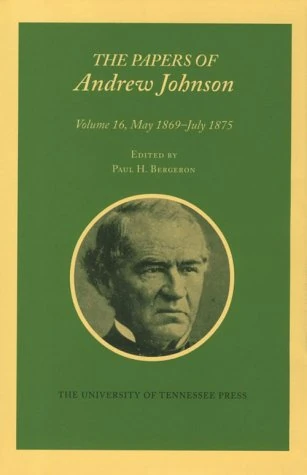
£68.95
It has never been this cheap. We have no record of a lower price.
£69 today · cheaper than every other day in the last 3 months
University of Tennessee Press The Papers of Andrew Johnson: May 1869-July 1875: 16: Volume 16 May 1869-July 1875 (Utp Papers Andrew Johnson)
Price data last checked 30 day(s) ago - will refresh soon
We'll watch every seller, every day. One email when your price arrives.
Price History & Forecast
Grey patches = out of stock. Cheaper = lower on the chart. Hover for exact prices.
Last 61 days · 61 data points (no recent data)
Price data last checked 30 day(s) ago - will refresh soon
NEW HERE?
Amazon shows you one price. We show you all of them.
Tosheroon watches Amazon prices so you don't have to. Every product on Amazon has a price history — we make it visible. Set the price you'd actually pay, and we'll email you the second it gets there. No app, no account, one email.
WHAT'S ON THIS PAGE
when this has been cheap or pricey
where the price is heading next
all-time high & low, recent range
name your number, we'll email you
Price Distribution
Price distribution over 61 days • 1 price levels
Price Analysis
Most common price: £69 (61 days, 100.0%)
Price range: £69 - £69
Price levels: 1 different prices over 61 days
Description
Product Specifications
- Format
- hardcover
- ASIN
- 1572330910
- Domain
- Amazon UK
- Release Date
- 15 September 2000
- Listed Since
- 13 February 2007
Barcode
No barcode data available
Similar Products You Might Like
The Papers of Andrew Johnson: September 1868 - April 1869 Volume 15 (UTP Papers Andrew Johnson)

Lyndon B Johnson: Pursuit of Populism - America's Presidents
Papers a Johnson Vol2: 1852-1857: 002 (Papers of Andrew Johnson) (Utp Papers Andrew Johnson)
Univ Tennessee Press

Southern Women at Vassar: The Poppenheim Family Letters, 1882-1916 (Women's Diaries & Letters of the South)
uscpress

The Johnson Years: The Johnson (Presidential Profiles)
Facts on File
Samuel Johnson: The Arc of the Pendulum
Oxford University Press

In the Shadow of the Great Rebellion: The Life of Andrew Johnson, Seventeenth President of the United States (1808-1875) (First Men, America's Presidents)

The Johnson Circle: A Group Portrait
Fairleigh Dickinson University Press
The Samuel Johnson Encyclopedia (Spie Proceedings Series; 2694)
Bloomsbury
Correspondence of James K. Polk: Vol 14, April 1848-June 1849
Univ Tennessee Press

Aesthetic Anxiety: Uncanny Symptoms in German Literature and Culture: 141 (Internationale Forschungen zur Allgemeinen und Vergleichenden Literaturwissenschaft, 141)
RODOPI

Let the Bells Ring Out - Festive Novel by Simon & Schuster
Simon & Schuster
Reading Samuel Johnson: Reception and Representation, 1750–1960 (Clemson University Press: Eighteenth-Century Moments)
Oxford University Press

Managing Global Strategy: Developing an Effective Strategy in International Business
Routledge

The Papers of Andrew Jackson 1832: Volume 10 (Utp Papers Andrew Jackson): Volume 10, 1832
Univ Tennessee Press
The Papers of Andrew Johnson: 009 (Utp Papers Andrew Johnson): Volume 9 September 1865-January 1866
Univ Tennessee Press
Lyndon Baines Johnson and the Uses of Power: 221 (Contributions in Political Science)
Bloomsbury

Political Consultants and Campaigns: One Day to Sell (Transforming American Politics)
Routledge
Papers a Johnson Vol 14: April-August 1868 (Papers of Andrew Johnson) (Utp Papers Andrew Johnson)
Univ Tennessee Press

Southern Women at the Seven Sister Colleges: Feminist Values and Social Activism, 1875-1915
University of Georgia Press

Middle-Class Life in Victorian Belfast: 15 (Reappraisals in Irish History)
Liverpool University Press
From School Administrator to School Leader: 15 Keys to Maximizing Your Leadership Potential (Eye on Education)
Routledge

Captain Bulloch: The Life of James Dunwoody Bulloch, Naval Agent of the Confederacy
Booklocker.com