£192.99

Dolomite: Formation, Characteristics & Environmental Impact (Geology and Mineralogy Research Developments)

Price data last checked 9 day(s) ago - will refresh soon

View at Amazon

We'll watch every seller, every day. One email when your price arrives.

It has never been this cheap. We have no record of a lower price.

£193 today · cheaper than every other day in the last 3 months

NEW HERE?

Amazon shows you one price. We show you all of them.

Tosheroon watches Amazon prices so you don't have to. Every product on Amazon has a price history — we make it visible. Set the price you'd actually pay, and we'll email you the second it gets there. No app, no account, one email.

WHAT'S ON THIS PAGE

↓ Price chart
when this has been cheap or pricey
↓ Forecast
where the price is heading next
↓ Statistics
all-time high & low, recent range
↑ Price alert
name your number, we'll email you

Price History & Forecast

Grey patches = out of stock. Cheaper = lower on the chart. Hover for exact prices.

Last 82 days · 82 data points (no recent data)

Historical
Generating forecast…
£192.99 £183.34 £187.20 £191.06 £194.92 £198.78 £202.64 25 April 2026 15 May 2026 04 June 2026 24 June 2026 15 July 2026

Price Distribution

Price distribution over 82 days • 1 price levels

Days at Price
82 days 0 21 41 62 82 £193 Days at Price

Price Analysis

Most common price: £193 (82 days, 100.0%)

Price range: £193 - £193

Price levels: 1 different prices over 82 days

Description

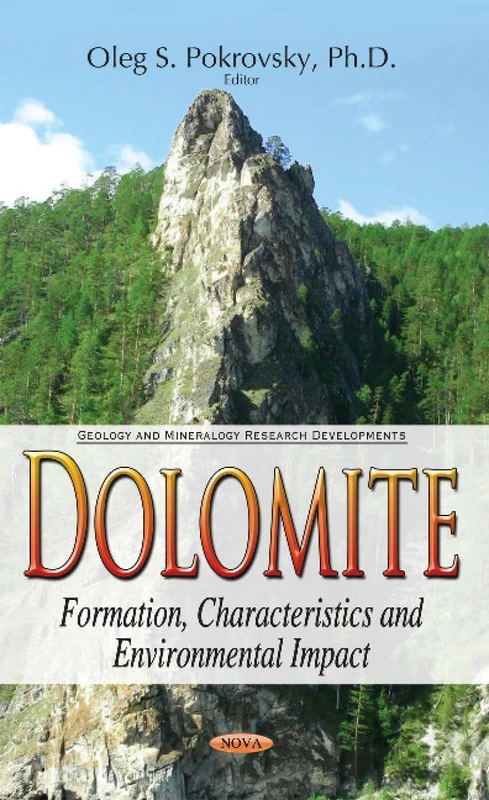
Dolomite (CaMg(CO)2) is certainly one of the most enigmatic sedimentary minerals on Earth. Its massive deposits of the past have very little contemporary analogues and today, scientists still do not have a consensus on how hundred meter-thick dolomite deposits of the Precambrian age (> 600 million year) were formed across the globe. Recently, the interest in dolomite has risen due to its importance as a major regulator not only of carbon cycle in the past, but also as an important host rock in ongoing projects of CO2 underground storage and sequestration. The growing demand for primary resources also impacted the interest in dolomite and dolomitic rocks, which are now widely used in numerous technological and industrial applications. For these reasons, there is a steady increase of scientific publications linked to dolomite problematics. A Web of Science search (all databases) with dolomite as the topic yielded more than 13,000 papers published from 1950-2015; 4,200 of them were published over the last five years and 8,800 were produced during preceding sixty years. The number of publications concerning use of dolomite in the field of engineering and physical science (non-earth sciences) increased five-fold from the mid-1990s to 2000s, and nowadays contributes to more than a half of all publications on dolomite. This clearly illustrates the rising interest in dolomite for technological applications over the past decade. This book incorporates a large number of disciplines, from geology to chemical engineering of catalysts. It illuminates three main aspects of dolomite as a major sedimentary rock and important technological material: (i) natural occurrence; (ii) laboratory study of dolomite dissolution and precipitation and (iii) applications in various technological aspects. The first two chapters address geological and mineralogical aspects of dolomite deposits in the natural environment (Wagner et al.; Marfil et al). The next three chapters cover the reactivity of dolomite in an aqueous solution (Pokrovsky and Schott), the synthesis of dolomite analogues from aqueous solution (Pina et al) and laboratory precipitation of Mg-bearing carbonates and protodolomite from homogeneous supersaturated solutions (Pokrovsky). Finally, the last two chapters (Ivanets et al., Ryabkov et al.) present the application of dolomite for numerous technological and engineering purposes. About the Author Oleg S Pokrovsky graduated from Geochemistry department, Moscow State University, PhD in geochemistry (1994), entered CNRS (FRANCE) in 1999 and works over past decade on biogeochemistry of arctic and subarctic rivers and lakes. He is now a research director at the CNRS (FRANCE). He possesses both experimental physico-chemical, microbiological and geochemical expertise. Over past decade, O S Pokrovsky directed and co-directed 12 PhD students, 5 Post-doctoral research associates. Since 2000, O S Pokrovsky coordinated and leaded more than 20 various research grants, international cooperation programs and consortia, large-scale national (French) grants and served as important partner of a number of European (FP7) projects. Since 2013, O S Pokrovsky, a recipient of a prestigious Mega-grant of Russian Ministry of Science and Education (3 M $ for 3 years), directs BIO-GEO-CLIM Laboratory on Environment, Climate and Permafrost at Tomsk State University. O S Pokrovsky has strong academic records with ~160 papers peer reviewed papers and the same number of conference abstracts published since 1992 on physical chemistry, experimental geochemistry, and aquatic biogeochemistry; his HI factor is equal to 35 and the total citation number is close to 4000.

Product Specifications

Format
hardcover
Domain
Amazon UK
Release Date
01 February 2017
Listed Since
19 December 2016

Barcode

No barcode data available