We can't find the internet
Attempting to reconnect
Something went wrong
Hang in there while we get back on track
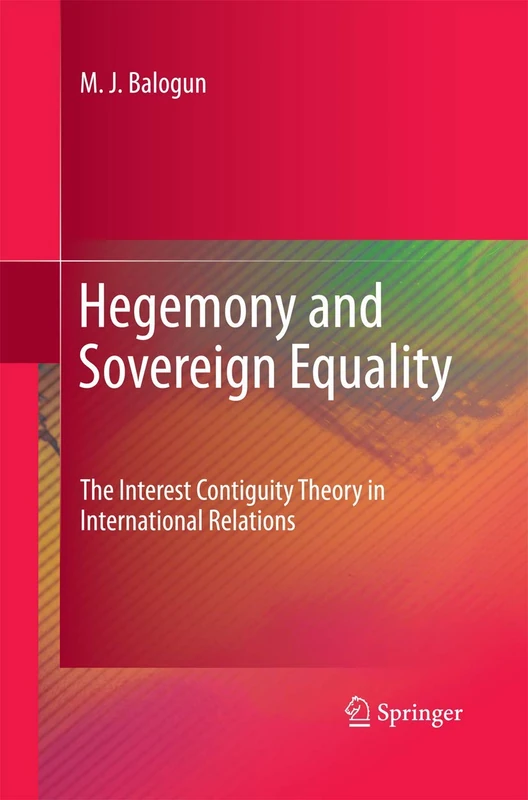
£103.27
Springer Hegemony and Sovereign Equality: The Interest Contiguity Theory in International Relations
Price data last checked 62 day(s) ago - refreshing...
We'll watch every seller, every day. One email when your price arrives.
This is the most expensive it has ever been. Walk away.
£103 today · previous high £103 · all-time low £103
NEW HERE?
Amazon shows you one price. We show you all of them.
Tosheroon watches Amazon prices so you don't have to. Every product on Amazon has a price history — we make it visible. Set the price you'd actually pay, and we'll email you the second it gets there. No app, no account, one email.
WHAT'S ON THIS PAGE
when this has been cheap or pricey
where the price is heading next
all-time high & low, recent range
name your number, we'll email you
Price History & Forecast
Grey patches = out of stock. Cheaper = lower on the chart. Hover for exact prices.
Last 29 days · 29 data points (no recent data)
Price Distribution
Price distribution over 29 days • 1 price levels
Price Analysis
Most common price: £103 (29 days, 100.0%)
Price range: £103 - £103
Price levels: 1 different prices over 29 days
Description
Product Specifications
- Brand
- Springer
- Format
- paperback
- ASIN
- 148998545X
- Domain
- Amazon UK
- Publication Date
- 01 October 2014
- Listed Since
- 01 October 2014
Barcode
No barcode data available
Similar Products You Might Like

Territorial Integrity in a Globalizing World: International Law and States’ Quest for Survival
Springer

International Law and the Relationality of States: A Critique of Theories of Recognition
Routledge

Conflicts in Environmental Regulation and the Internationalisation of the State: Contested Terrains: 25 (RIPE Series in Global Political Economy)
Routledge

A History of International Political Theory: Ontologies of the International
MACMILLAN

Hegemony in International Relations: Theory and Practice
Routledge
Re-envisioning Sovereignty: The End of Westphalia? (Law, Ethics and Governance)
Routledge

Global Theory from Kant to Hardt and Negri (International Political Theory)
MACMILLAN

International Political Theory after Hobbes: Analysis, Interpretation and Orientation
MACMILLAN

Political Hegemony and Social Complexity: Mechanisms of Power After Gramsci (International Political Theory)
MACMILLAN

Controversies in International Relations Theory: Realism and the Neo-Liberal Challenge
Red Globe Press

Neo-Liberalism, State Power and Global Governance
Springer

Territorial Disputes and State Sovereignty: International Law and Politics (Routledge Research in International Law)
Routledge

Globalization and Sovereignty: Rethinking Legality, Legitimacy, and Constitutionalism
Cambridge University Press

After the Globe, Before the World (Global Horizons)
Routledge

Freedom, Recognition and Non-Domination: A Republican Theory of (Global) Justice: 12 (Studies in Global Justice, 12)
Springer

Great Powers and Geopolitics: International Affairs in a Rebalancing World (Global Power Shift)
Springer

Autobiographical International Relations: I, IR (Interventions)
Routledge

Critical Imaginations in International Relations (Interventions)
Routledge

State, Globalization and Multilateralism: The challenges of institutionalizing regionalism: 5 (United Nations University Series on Regionalism, 5)
Springer

Theology and World Politics: Metaphysics, Genealogies, Political Theologies (International Political Theory)
MACMILLAN

Limitations of National Sovereignty through European Integration: 51 (Ius Gentium: Comparative Perspectives on Law and Justice, 51)
Springer

Sovereignty Games: Instrumentalizing State Sovereignty in Europe and Beyond (Governance, Security and Development)
MACMILLAN

Drones and Global Order: Implications of Remote Warfare for International Society (Contemporary Security Studies)
Routledge

Hegemony, International Political Economy and Post-Communist Russia (Post-Soviet Politics)
Routledge