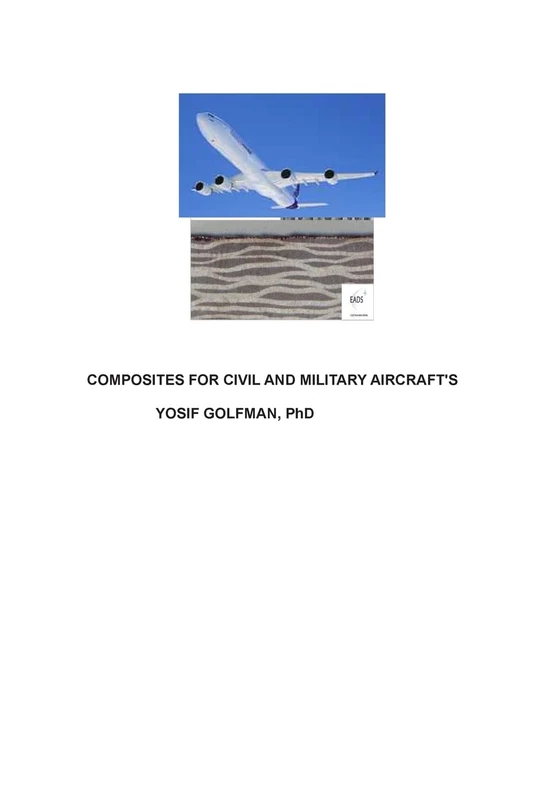
Brief Description Lightweight and fatigue strength of composites boost applications in Civil and Military Aircraft's. Boeing 787 Dream Lines and Civil Airbus A350 C-17 Transport uses 50% composites. Carbon fiber composites have a high strength-to -weight ratio than traditional aircraft and carbon fiber in 2.5 times lighter than titanium. Composites are used on fuselage, wings, tail, doors and interior. Civil Boeing with composites has a sonic properties and Bell Boeing V-22 Osprey military transport uses also 50% composites. Civil Airbus A350 use composite panels on a frame and C-17 transport has over 16,000 lb(7300kg) of structural composites. Carbon fiber, unlike metals does not visibly show cracks and fatigue, prompting concerns about safety risks. The develop the biggest, fastest 3D printer for making titanium aircraft and satellite components is task for feature and may be include in program modernization F-35 Lockheed Martin Inc. Titanium has been used for several years in the manufacturing of aircraft components, primarily via machining. Print 3D Technologies use titanium wires Ti-6AL-4V which melt by laser CO2 and can create all parts of aircraft's. This book consist from fourteen parts: in part 1 we investigate application civil and military aircraft's; part 2 devote of wing hybrid technology, part 3 consists of braiding carbon fiber fuselage , wings hybrid technology was shown in chapter 4; composite braided cockpit represents in part 5, technological printing process we investigate in ch.6, 3D printing process for Aviation parts and design modeling for prototyping we conform in part 7; Part 8 devote strength components, physical and mechanical properties titanium alloys, like Ti-Al-4V and physical and mechanical properties ceramics, like SiC. Chapter 9 devote for dynamic stability of lattice structures,we investigate dynamic stability of Jetliners in Chapter 10; fatigue strength carbon fiber epoxy aviation structures dominate in chapter 11. Chapter 12, unmanned aerial vehicle-drones organically continuous carbon fiber application in special vehicles. Paragraph 13 consider the Aircraft's noise and Sound Emission. Chapter 14 includes powerful and lightweight lithium-ion and aluminum-ion batteries. Purpose of all chapters to help students and researches to find a optimal way for design and select technology’s with minimum cost and optimal safety risk. About the Author Yosif Golfman, PhD, Director Structural Materials, Neo-Advent Technologies LLC, email: Yosif105@hotmail.com, tel.978-371-3349 Yosif Golfman graduated from the Shipbuilding Institute, Leningrad, USSR. He has been involved in R&D composites since 1960, working as a Research Composite Engineer at the Shipbuilding Technology Institute, Leningrad, USSR. He defended PhD in Shipbuilding Institute at 1969 year. His works investigated the influence of technological factors, fiber prepregs and resins, on the strength of fiberglass propellers and blades. He has applied for immigration to USA in 1977, and got refuse. When Gorbachev came to power, he got permission only in 1988. In the United States he worked as a Research Engineer at Ad Tech Systems Research in Dayton, Ohio, as a Mechanical Engineer at Foster-Miller Inc., Waltham, MA, and as a Process Mechanical Engineer at Spectran Inc., Sturbridge MA. In Spectran Inc. he developed a vapor deposition coating control Nan ceramics particles on the draw optical glass fibers. In Neo-Advent Technologies Inc. he worked for design, technology development, and manufacturing of light weight nanoscale structures parts based on ceramic, and thermoplastics, and liquid polymers, and carbon fiber textiles for aerospace applications and space vehicles. He published 30 articles in Journals like Journal of Advanced Materials, Reinforced Plastics & Composites and JEC Magazine Composites.