We can't find the internet
Attempting to reconnect
Something went wrong
Hang in there while we get back on track
£220.00
This is the most expensive it has ever been. Walk away.
£220 today · previous high £220 · all-time low £97
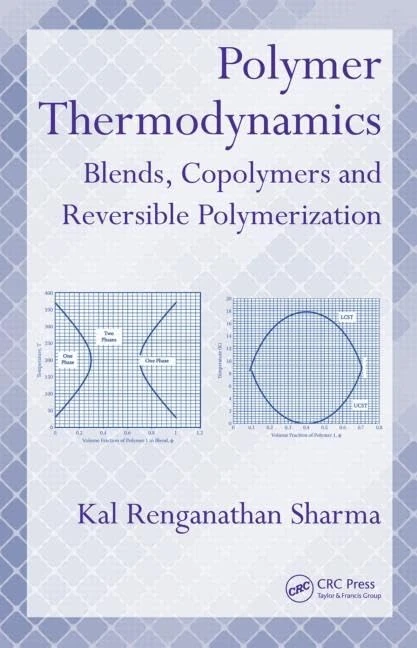
CRC Press Polymer Thermodynamics: Blends, Copolymers and Reversible Polymerization
Illustrated
Price data last checked 29 day(s) ago - will refresh soon
We'll watch every seller, every day. One email when your price arrives.
Price History & Forecast
Grey patches = out of stock. Cheaper = lower on the chart. Hover for exact prices.
Last 62 days · 62 data points (no recent data)
Illustrated
Price data last checked 29 day(s) ago - will refresh soon
NEW HERE?
Amazon shows you one price. We show you all of them.
Tosheroon watches Amazon prices so you don't have to. Every product on Amazon has a price history — we make it visible. Set the price you'd actually pay, and we'll email you the second it gets there. No app, no account, one email.
WHAT'S ON THIS PAGE
when this has been cheap or pricey
where the price is heading next
all-time high & low, recent range
name your number, we'll email you
Price Distribution
Price distribution over 62 days • 3 price levels
Price Analysis
Most common price: £97 (47 days, 75.8%)
Price range: £97 - £220
Price levels: 3 different prices over 62 days
Description
Product Specifications
- Brand
- CRC Press
- Model
- Illustrated
- Format
- hardcover
- ASIN
- 1439826390
- Domain
- Amazon UK
- Release Date
- 10 October 2011
- Listed Since
- 26 October 2009
Barcode
No barcode data available
Similar Products You Might Like
Fundamentals of Polymer Science: An Introductory Text, Second Edition
Routledge

Fundamentals de Ciencia de Polimeros: Un Texto Introductorio
CRC Press
Oxford University Press Polymer Physics Textbook - Chemistry
Oxford University Press

Deformation and Flow of Polymeric Materials
Springer

Polymer Thermodynamics: Liquid Polymer-Containing Mixtures: 238 (Advances in Polymer Science, 238)
Springer

CRC Press Principles of Polymer Systems - Sixth Edition
CRC Press
Materials Science of Polymers: Plastics, Rubber, Blends and Composites
CRC Press

Concise Encyclopedia of Polymer Science and Engineering
Wiley
Price unavailable
Materials Science of Polymers: Plastics, Rubber, Blends and Composites
CRC Press
Conformation-Dependent Design of Sequences in Copolymers I: 195 (Advances in Polymer Science, 195)
Springer

New Trends in Nonionic (Co) Polymers and Hybrids

Polymers and Multicomponent Polymeric Systems: Thermal, Thermo-Mechanical and Dielectric Analysis
CRC Press
Modification and Blending of Synthetic and Natural Macromolecules: Proceedings of the NATO Advanced Study Institute on Modification and Blending of ... II: Mathematics, Physics and Chemistry, 175)
Springer

Multiphase Polymer Systems: Micro- to Nanostructural Evolution in Advanced Technologies
CRC Press
Polymer Chemistry: International Student Edition
CRC Press

Organic-Inorganic Hybrid Nanomaterials: 267 (Advances in Polymer Science, 267)
Springer
CRC Handbook of Phase Equilibria and Thermodynamic Data of Aqueous Polymer Solutions
CRC Press
Introduction to Physical Polymer Science, 3rd edition
Wiley
Price unavailable
Structure―Property Relationships in Polymers
Springer

New Perspectives in Chemistry and Biochemistry
Brand: Nova Science Pub Inc

Polymers: A Property Database, Second Edition
CRC Press

Thermal Properties of Bio-based Polymers: 283 (Advances in Polymer Science, 283)
Springer