£51.79

It has never been this cheap. We have no record of a lower price.

£52 today · cheaper than every other day in the last 3 months

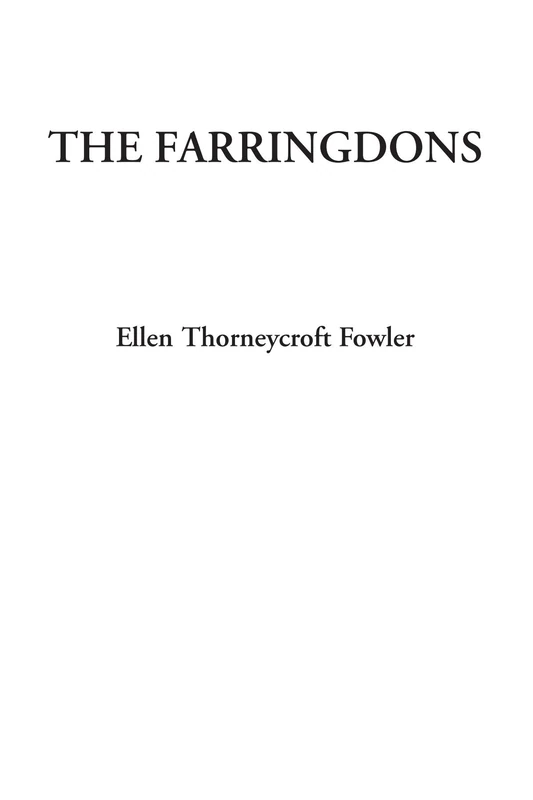
The Farringdons

View at Amazon

Price History & Forecast

Grey patches = out of stock. Cheaper = lower on the chart. Hover for exact prices.

Last 61 days · 61 data points (no recent data)

Historical
Generating forecast…
£51.79 £49.20 £50.24 £51.27 £52.31 £53.34 £54.38 25 July 2026 09 August 2026 24 August 2026 08 September 2026 23 September 2026
View at Amazon ↗

Price data last checked 30 day(s) ago - will refresh soon

NEW HERE?

Amazon shows you one price. We show you all of them.

Tosheroon watches Amazon prices so you don't have to. Every product on Amazon has a price history — we make it visible. Set the price you'd actually pay, and we'll email you the second it gets there. No app, no account, one email.

WHAT'S ON THIS PAGE

↑ Price chart
when this has been cheap or pricey
↑ Forecast
where the price is heading next
↓ Statistics
all-time high & low, recent range
↑ Price alert
name your number, we'll email you

Price Distribution

Price distribution over 61 days • 1 price levels

Days at Price
61 days 0 15 31 46 61 £52 Days at Price

Price Analysis

Most common price: £52 (61 days, 100.0%)

Price range: £52 - £52

Price levels: 1 different prices over 61 days

Description

When From "The Speaker, the Liberal Review," Vol. 2 [1900]: A NOVEL OF THE FUTURE OUR readers may recollect a recent humorous picture of the probable ultimate condition of the human species. Their brains had immensely outgrown their bodies, and they were sitting all head, like great eggs, on the edge of a pool, contemplating themselves therein and needing little other nourishment. It would be an interesting speculation whether fiction also will end in some one character serenely contemplating its own brains. A tendency in that direction is traceable in such of Miss Ellen Fowler’s novels as have achieved distinction. Any advance they show is towards uniformity of cleverness; there was less power of depicting variety of character in The Double Thread than in Concerning Isabel Carnaby. In the present novel there is a frank concentration of all Miss Fowler's abilities on one character. The novel with her is becoming a dramatic monologue, with this advantage over a monologue—that the authoress is able to employ herself and a chorus in describing the emotions of the protagonist. What is this one character in The Farringdons? Elizabeth Farringdon's Methodist education only serves to sharpen her Wit at the expense of Methodists, who, for that reason, not unnaturally perhaps, somewhat dislike her. By virtue of her wit and fluency she naturally gravitates to town society, where, in spite of a remark to the effect that artists and aristocrats are separate, she is thoroughly at home. For Elizabeth, though an artist, has not an artist’s cleverness: true artists do not so readily explain their feelings; she is at heart urban. Her comments on town society show an understanding of its psychological elements, its pluck, its lightheartedness, and that individualistic tendency which, prevented by convention from showing itself in ruder forms, finds issue in a straining after epigram and effect. She understands them because she, like Isabel Carnaby, is one of them. For the artistic qualities which Miss Fowler gives this latest heroine are unimportant and, if anything, depreciate from the interest of her character. They show her in so selfish a light that we feel she deserves all she does and does not get, and we are inclined to doubt the effectiveness of a conversion to religion which left the original character so unchanged. But this one character asserting itself through the medium of epigram hampers the authoress. Firstly, it affects her style. Epigram is nowhere excluded. Beneath the conventional ungrammaticisms of the cottage flashes the wit of Lady Silverhampton and the fine sensibility of the Slade School of Art. Sometimes it is ludicrous, as when the slighted Christopher on ins sick-bed talks in as neatly rounded periods as Tremaine in the fullness of his artistic health. Sometimes it is in positive bad taste as when, speaking of the death of Elizabeth’s aunt, it is said that "Miss Maria Farringdon went to sleep one night in a land whose stones are of iron and awoke next morning in a country whose pavements are of gold." We feel that nature is continually being looked at through town eyes with a view to effect: it may have the occasional charm of Watteau; it lacks the simple truth of Gainsborough....

Product Specifications

Format
paperback
Domain
Amazon UK
Release Date
05 March 2007
Listed Since
12 March 2007

Barcode

No barcode data available