£110.39

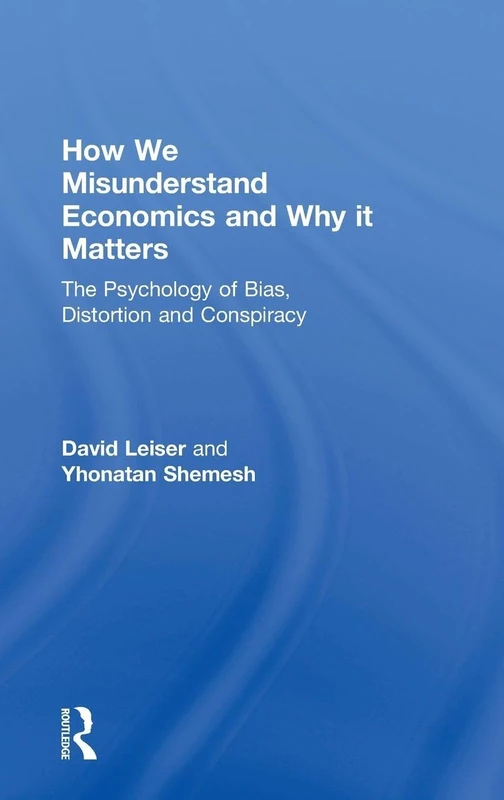
Routledge How We Misunderstand Economics and Why it Matters: The Psychology of Bias, Distortion and Conspiracy

Price data last checked 99 day(s) ago - refreshing...

View at Amazon

We'll watch every seller, every day. One email when your price arrives.

It has never been this cheap. We have no record of a lower price.

£110 today · cheaper than every other day in the last 24 months

NEW HERE?

Amazon shows you one price. We show you all of them.

Tosheroon watches Amazon prices so you don't have to. Every product on Amazon has a price history — we make it visible. Set the price you'd actually pay, and we'll email you the second it gets there. No app, no account, one email.

WHAT'S ON THIS PAGE

↓ Price chart
when this has been cheap or pricey
↓ Forecast
where the price is heading next
↓ Statistics
all-time high & low, recent range
↑ Price alert
name your number, we'll email you

Price History & Forecast

Grey patches = out of stock. Cheaper = lower on the chart. Hover for exact prices.

Last 632 days • 632 data points (No recent data available)

Historical
Generating forecast...
£130.00 £108.43 £113.14 £117.84 £122.55 £127.25 £131.96 07 July 2024 11 December 2024 18 May 2025 23 October 2025 30 March 2026

Price Distribution

Price distribution over 632 days • 3 price levels

Days at Price
Current Price
606 days · current 10 days 16 days 0 152 303 455 606 £110 £111 £130 Days at Price

Price Analysis

Most common price: £110 (606 days, 95.9%)

Price range: £110 - £130

Price levels: 3 different prices over 632 days

Description

This is the first book to explain why people misunderstand economics. From the cognitive shortcuts we use to make sense of complex information, to the metaphors we rely on and their effect on our thinking, this important book lays bare not only the psychological traits that distort our ability to understand such a vital topic, but also what this means for policy makers and civil society more widely. Accessibly written, the book explores the mismatch between the complexities of economics and the constraints of human cognition that lie at the root of our misconceptions. The authors document and explain the gamut of cognitive strategies laypeople employ as they grapple with such complex topics as inflation, unemployment, economic crises, finance, and money in the modern economy. The book examines sources of misconceptions ranging from the intentionality fallacy, whereby economic phenomena are assumed to have been caused deliberately rather than to have come about by an interplay of many agents and causal factors, to the role of ideology in framing economic thinking. Exposing the underlying biases and assumptions that undermine financial and economic literacy, and concluding with recommendations for how policies and ideas should be framed to enable a clearer understanding, this will be essential reading not only for students and researchers across psychology and economics, but also anyone interested in progressive public policy. Visit the associated website for the book here: http://www.misunderstandeconomics.com/ Review "This engagingly written book takes us above and beyond traditional judgment and decision-making studies and the heuristics and biases of behavioral economics to explore how people develop explanatory models and concepts in the domain of economics. It contains many fascinating insights into the challenges laypeople have in understanding seemingly simple but deeply complex phenomena and economic entities (e.g. money), as well as offering a bold new direction for research into a topic where greater lay understanding has enormous social policy consequences." - Frank Keil, Yale University, USA "For decades economists have tidily cultivated their own scientific gardens and forgotten that complex socio-economic issues may be effectively tackled with better knowledge of human beings on top of sophisticated equations. A plea for a multidisciplinary approach, this book is a much-needed attempt to foster dialogue and bridge the cognitive segmentation of social sciences." -Elsa Fornero, University of Turin, Italy "In recent years, many economists have used psychology to understand the economy better. In their enlightening new book, Leiser and Shemesh use psychology to explain why most people understand economics so poorly. Economics insights often butt against deep-rooted ways of thinking about the world. And even when the lessons of economics are intuitive, economists’ rhetoric is not. How We Misunderstand Economics and Why It Matters is a great book for anyone who wants to understand the economy – or explain it to others." - Bryan Caplan, George Mason University, USA "Economists often express dismay at the failure of the public to understand economics. In this book, the authors (a behavioural economists and a cognitive psychologist) aim to explain why people misunderstand economics, ranging from topics like home sales and stocks to income and inflation. They reveal the cognitive shortcuts we use to make sense of complex information ('folk-economic beliefs'), the metaphors we rely on, and their effect on our thinking. They also point to the psychological traits that distort our ability to understand such vital topics."― Journal of Consumer Policy "David Leiser and Yhonatan Shemesh provide an elegant and striking analysis of the behavioural origins of public misperceptions of the logic and development of modern economics, and of their implications for public policy." - Egor Bronni

Product Specifications

Format
hardcover
Domain
Amazon UK
Release Date
21 May 2018
Listed Since
01 March 2017

Barcode

No barcode data available