£1,031.27

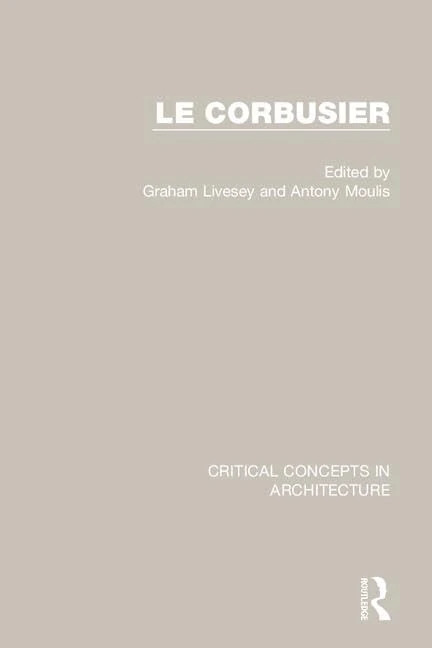
Routledge Le Corbusier (Critical Assessments in Architecture)

Price data last checked 9 day(s) ago - will refresh soon

View at Amazon

We'll watch every seller, every day. One email when your price arrives.

This is the most expensive it has ever been. Walk away.

£1,031 today · previous high £1,031 · all-time low £1,011

NEW HERE?

Amazon shows you one price. We show you all of them.

Tosheroon watches Amazon prices so you don't have to. Every product on Amazon has a price history — we make it visible. Set the price you'd actually pay, and we'll email you the second it gets there. No app, no account, one email.

WHAT'S ON THIS PAGE

↓ Price chart
when this has been cheap or pricey
↓ Forecast
where the price is heading next
↓ Statistics
all-time high & low, recent range
↑ Price alert
name your number, we'll email you

Price History & Forecast

Grey patches = out of stock. Cheaper = lower on the chart. Hover for exact prices.

Last 82 days · 82 data points (no recent data)

Historical
Generating forecast…
£1,031.27 £1,009.19 £1,014.01 £1,018.83 £1,023.64 £1,028.46 £1,033.28 26 April 2026 16 May 2026 05 June 2026 25 June 2026 16 July 2026

Price Distribution

Price distribution over 82 days • 2 price levels

Days at Price
Current Price
9 days 73 days · current 0 18 37 55 73 £1011 £1031 Days at Price

Price Analysis

Most common price: £1031 (73 days, 89.0%)

Price range: £1011 - £1031

Price levels: 2 different prices over 82 days

Description

Le Corbusier (1887-1965), born Charles-Édouard Jeanneret-Gris in La Chaux-de-Fonds (Switzerland), is considered by many to be the most influential architect of the twentieth century. Educated in his hometown in the Arts and Crafts tradition under his mentor Charles L’Éplattenier, his early training included important travels and periods of work in the offices of the Perret Brothers (Paris) and Peter Behrens (Berlin). He settled permanently in Paris in 1917, after which he encountered the modernist painter Amedée Ozenfant who would have a significant influence on his work; together they established Purism and the L’Esprit Nouveau journal. During this period he also took the name Le Corbusier derived from the name of a relative. The 1920s saw Le Corbusier emerge as one of the leading modern architects internationally with his designs for a series of villas and projects for the modern city. His ‘white’ architecture of this period was inspired by modern machines, including early aircraft, automobiles, and ocean liners, along with an abiding interest in architectural history. Many of his ideas were captured in two important publications: Vers une architecture (1923) and Urbanisme (1925). In the early 1930s he sought larger commissions internationally and his architecture evolved away from the Purist work of the 1920s with the adoption of vernacular elements. As the political climate in Europe changed in the late 1930s Le Corbusier’s career struggled leading him to take desperate measures. For example, during World War II, he attempted unsuccessfully to secure commissions from the Vichy regime controlling southern France. During this period he also began work on his Modulor measurement system. At the end of the work he reestablished his office in Paris and embarked on a creative and productive period that would last until his death by drowning in 1965. Of particular importance was the Unité d’Habitation project in Marseilles, begun in 1946, which allowed him to develop his ideas for collective housing; this project also signaled the emergence of his ‘brutalist’ period. His formal experiments also broadened with works such as the pilgrimage church of Notre Dame-du-Haut at Ronchamp and the monastery of La Tourette. In 1950 he was invited to India, where he was engaged to take over the master plan of the new capital city of the Punjab at Chandigarh. This allowed him to test his urban theories and to develop designs for the Capitol complex. A series of late work demonstrated Le Corbusier’s continuing experiments in architecture. Often unfairly maligned for the failings of modern urbanism, Le Corbusier’s legacy continues to evolve. This four-volume collection of writings on the career and legacy of Le Corbusier traces the various periods of his life from his early training to his final projects. The writings, by Le Corbusier and leading scholars, also explore important themes and specific buildings. The final volume includes articles, some critical of his ideas, which examine his legacy and impact.

Product Specifications

Format
hardcover
Domain
Amazon UK
Release Date
01 October 2016
Listed Since
18 August 2015

Barcode

No barcode data available