£84.99

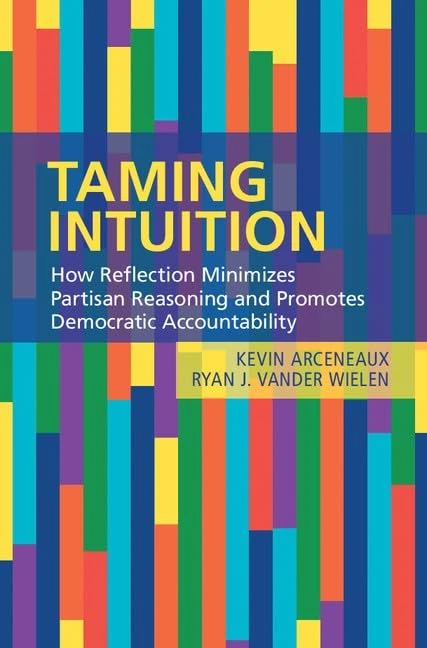
Cambridge University Press Taming Intuition: How Reflection Minimizes Partisan Reasoning and Promotes Democratic Accountability

Price data last checked 85 day(s) ago - refreshing...

View at Amazon

We'll watch every seller, every day. One email when your price arrives.

It has never been this cheap. We have no record of a lower price.

£85 today · cheaper than every other day in the last 3 months

NEW HERE?

Amazon shows you one price. We show you all of them.

Tosheroon watches Amazon prices so you don't have to. Every product on Amazon has a price history — we make it visible. Set the price you'd actually pay, and we'll email you the second it gets there. No app, no account, one email.

WHAT'S ON THIS PAGE

↓ Price chart
when this has been cheap or pricey
↓ Forecast
where the price is heading next
↓ Statistics
all-time high & low, recent range
↑ Price alert
name your number, we'll email you

Price History & Forecast

Grey patches = out of stock. Cheaper = lower on the chart. Hover for exact prices.

Last 6 days · 6 data points (no recent data)

Historical
Generating forecast…
£84.99 £80.74 £82.44 £84.14 £85.84 £87.54 £89.24 14 April 2026 15 April 2026 16 April 2026 17 April 2026 19 April 2026

Price Distribution

Price distribution over 6 days • 1 price levels

Days at Price
6 days 0 2 3 5 6 £85 Days at Price

Price Analysis

Most common price: £85 (6 days, 100.0%)

Price range: £85 - £85

Price levels: 1 different prices over 6 days

Description

The success of democratic governance hinges on an electorate's ability to reward elected officials who act faithfully and punish those who do not. Yet there is considerable variation among voters in their ability to objectively evaluate representatives' performance. In this book the authors develop a theoretical model, the Intuitionist Model of Political Reasoning, which posits that this variation across voters is the result of individual differences in the predisposition to reflect on and to override partisan impulses. Individuals differ in partisan intuitions resulting from the strength of their attachments to parties, as well as the degree to which they are willing to engage in the cognitively taxing process of evaluating those intuitions. The balance of these forces - the strength of intuitions and the willingness to second guess one's self - determines the extent to which individuals update their assessments of political parties and elected officials in a rational manner. Review 'Arceneaux and Vander Wielen's book is transformative as it explores a question that has been ignored when it comes to democratic citizenship: what happens when citizens reflect? They develop an impressive theory and use state-of-the-art methods to show that reflection fundamentally alters how citizens reason and make decisions. The book not only alters common understandings of citizens' behaviors, but also sets an agenda for the future of all research on democratic citizenship.' James N. Druckman, Payson S. Wild Professor of Political Science, Northwestern University'In this remarkable book, Arceneaux and Vander Wielen apply dual-process models of how people think to questions of how they reason about politics. They develop and refine a powerful conceptual model and then provide insightful, innovative empirical tests. I have long been looking for a book like this one that integrates recent insights about human cognition with long-standing questions about how voters think. This ambitious, thought-provoking research should be read by anyone who wants to understand the role of intuition and reflection in voter decision-making.' Daniel Hopkins, University of Pennsylvania'This book takes on one of the most important political questions of our time. Its central argument, and the evidence presented in support of it, is exciting and provocative. To date, no one has figured out how to reduce the myriad information-processing biases identified by Motivated Reasoning Theory that produce the polarization and lack of compromise plaguing our current politics. Unfortunately, giving people new and credible information in particular, and even education in general, often exacerbates these biases. The more subtle answer offered by Arceneaux and Vander Wielen is that those with the ability to coolly reflect on controversial topics can avoid making these common mistakes. Now if we can only figure out how to train people to hold such a rare combination of curiosity and cool-headedness! Taming Intuition will, at the very least, be an important voice in an important debate.' Nicholas Valentino, University of Michigan Book Description Individuals vary in their ability to reflect on and override partisan impulses, affecting their ability to rationally evaluate politicians. About the Author Kevin Arceneaux is Professor of Political Science, Faculty Affiliate with the Institute for Public Affairs, and Director of the Behavioral Foundations Lab at Temple University. He studies political psychology and political communication, focusing on how the interaction between political messages and people's political predispositions shapes attitudes and behavior. He is co-author of Changing Minds or Changing Channels (2013), which investigates the influence of ideologically slanted news programming and received the 2014 Goldsmith Book Prize from Harvard University. His work has also been published in the American Political Science

Product Specifications

Format
Hardcover
Domain
Amazon UK
Release Date
11 August 2017
Listed Since
01 March 2017

Barcode

No barcode data available