£173.72

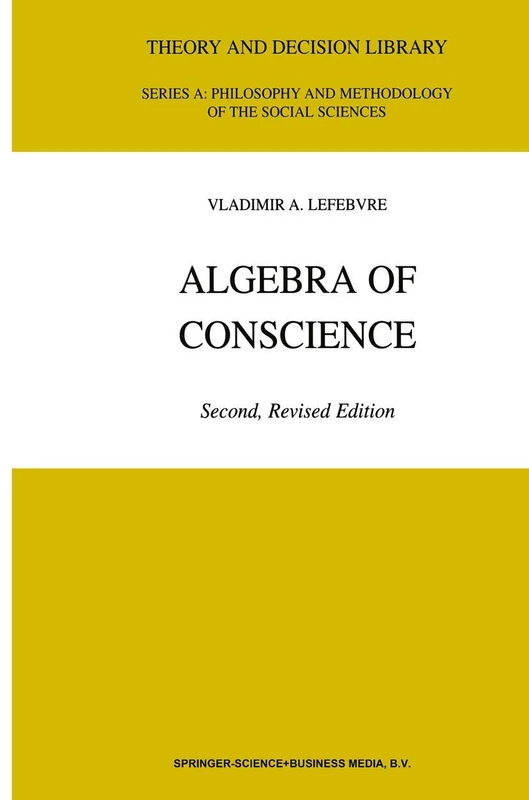
Springer Algebra of Conscience: 30 (Theory and Decision Library A:, 30)

Price data last checked 10 day(s) ago - will refresh soon

View at Amazon

We'll watch every seller, every day. One email when your price arrives.

Pricier than usual. £9 more than the 30-day average — we'd wait.

£174 today · 30-day average £165 · all-time low £160

NEW HERE?

Amazon shows you one price. We show you all of them.

Tosheroon watches Amazon prices so you don't have to. Every product on Amazon has a price history — we make it visible. Set the price you'd actually pay, and we'll email you the second it gets there. No app, no account, one email.

WHAT'S ON THIS PAGE

↓ Price chart
when this has been cheap or pricey
↓ Forecast
where the price is heading next
↓ Statistics
all-time high & low, recent range
↑ Price alert
name your number, we'll email you

Price History & Forecast

Grey patches = out of stock. Cheaper = lower on the chart. Hover for exact prices.

Last 81 days · 81 data points (no recent data)

Historical
Generating forecast…
£178.36 £157.61 £162.14 £166.67 £171.19 £175.72 £180.25 26 April 2026 16 May 2026 05 June 2026 25 June 2026 15 July 2026

Price Distribution

Price distribution over 81 days • 5 price levels

Days at Price
Current Price
14 days 11 days 1 day · current 6 days 49 days 0 12 25 37 49 £160 £170 £174 £175 £178 Days at Price

Price Analysis

Most common price: £178 (49 days, 60.5%)

Price range: £160 - £178

Price levels: 5 different prices over 81 days

Description

Conscience is an essential human attribute. Nevertheless, in the construction of formal models of the subject it is customarily left outside the framework of theoretical analysis. The Algebra of Conscience, whose first edition appeared in 1982, was the first specialized work modeling the phenomenon of conscience. The method used in this book made it possible to connect moral experience with decision-making procedures on the level of mathematical models. The application of such models allows us to propose the hypothesis of two fundamentally different ethical systems determining the normative patterns of human behavior in situations of conflict. Under the first ethical system the subject's self-esteem is raised if the subject seeks to resolve the conflict; in the second it is raised by seeking to dramatize the conflict. The new edition of The Algebra of Conscience is significantly expanded. The second part of the book, devoted to moral choice, is completely new. Based on the theory presented in the first part, it constructs the model of a subject capable of making an intentional choice. A special variable corresponds to the subject's intention. This development allows us to include within the model freedom of will and freedom of choice, and also to generalize classical 2×2 game theory to the case where outcomes, in addition to having utility measures, are either `positive' or `negative.' In its concluding chapters the book constructs a dynamic model of the intentional subject faced with a choice between two alternatives, neither of which is morally acceptable for the subject. It is shown that in this case the probabilities of choice of the alternatives may change chaotically. From this it follows that one cannot predict which alternative will be chosen or even the probabilities with which they will be chosen. Audience: The book is addressed to a broad readership having elementaryknowledge of mathematical logic and the theory of probability. It can be used in college courses studying the modelling of moral choice. The book's material can also be used in the design of artificial intelligence systems.

Product Specifications

Format
hardcover
Domain
Amazon UK
Release Date
31 July 2001
Listed Since
28 December 2006

Barcode

No barcode data available