£61.36

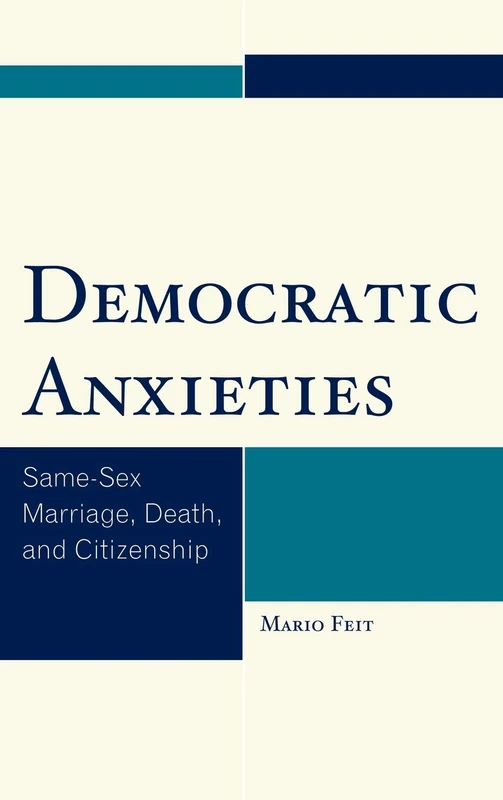
Lexington Books Democratic Anxieties: Same-Sex Marriage, Death, and Citizenship

Price data last checked 84 day(s) ago - refreshing...

View at Amazon

We'll watch every seller, every day. One email when your price arrives.

This is the most expensive it has ever been. Walk away.

£61 today · previous high £61 · all-time low £55

NEW HERE?

Amazon shows you one price. We show you all of them.

Tosheroon watches Amazon prices so you don't have to. Every product on Amazon has a price history — we make it visible. Set the price you'd actually pay, and we'll email you the second it gets there. No app, no account, one email.

WHAT'S ON THIS PAGE

↓ Price chart
when this has been cheap or pricey
↓ Forecast
where the price is heading next
↓ Statistics
all-time high & low, recent range
↑ Price alert
name your number, we'll email you

Price History & Forecast

Grey patches = out of stock. Cheaper = lower on the chart. Hover for exact prices.

Last 7 days · 7 data points (no recent data)

Historical
Generating forecast…
£61.36 £53.96 £55.57 £57.19 £58.80 £60.42 £62.03 14 April 2026 15 April 2026 17 April 2026 18 April 2026 20 April 2026

Price Distribution

Price distribution over 7 days • 2 price levels

Days at Price
Current Price
6 days 1 day · current 0 2 3 5 6 £55 £61 Days at Price

Price Analysis

Most common price: £55 (6 days, 85.7%)

Price range: £55 - £61

Price levels: 2 different prices over 7 days

Description

Democratic Anxieties: Same-Sex Marriage, Death, and Citizenship proceeds from the surprising parallels between straight and gay opponents of same-sex marriage. With their apocalyptic rhetoric they inadvertently point to a frequently neglected, existential dimension of democratic citizenship. Democratic Anxieties argues that we must pay attention to the existential significance of democratic citizenship, because otherwise we end up with anxious democracy-a democracy that cannot fully embrace pluralism, especially when the connections between sex, death, and citizenship are at stake. This book pursues a less anxious conception of democratic citizenship in chapters on Jean-Jacques Rousseau, Hannah Arendt, and Friedrich Nietzsche. Feit reveals how Rousseau diminishes democratic citizenship by linking it to existential consolation via sexual reproduction. He interprets Arendt as a queer theorist, because she rejects the heteronormative pursuit of reproductive immortality. Yet, the hope for immortality persists within Arendt's conception of political action, which delimits its democratic potential. Feit argues that Nietzsche resists both Rousseau's political idealization of heterosexuality and Arendt's anxious alternative. Calling for an affirmation of death, Nietzsche, creatively reimagines sexual as well as cultural reproduction, that is, pluralizes democratic citizenship. The resulting, more existentially aware democratic politics not only contributes to lesbian and gay equality, but is also critical in a post-September 11 world. Review Feit discovers heteronormativity in Rousseau's account of citizenship, suggesting he employs unease about death as a way to direct the sexuality of citizens toward reproduction, which allows the community to continue and to express consent. Feit's Hannah Arendt rejects this heteronormativity but does not overcome the anxiety about death that gives rise to it, thus leaving entire areas of life separate from politics. Feit's Nietzsche promotes a pluralism that lacks the anxieties of Rousseau or Arendt, accepts death, and allows for what Feit calls 'queer forms of reproduction.' His discussions of Rousseau, Arendt, and Nietzsche are ministerial to his engagement with contemporary queer theory and the question of same-sex marriage and citizenship. The strength of Feit's work ultimately lies in his own engagements with queer theory, and the true value of the book is the originality of his account of the disagreement over same-sex marriage, which could have been expanded. Best for advanced students and scholars working on questions of citizenship and same-sex marriage; the book may be too theoretically advanced for undergraduates.-- (12/01/2011) Democratic Anxieties is an interesting and timely book on an important issue. Displaying an admirable balance between advocacy and analysis, Feit brings considerable scholarship to bear on the topic, offering some new and unexpected readings of canonical texts in the process. Refreshingly free from jargon and neologisms, the book is clearly argued and judicious in its presentation of positions with which it disagrees. Feit's work is a telling reminder that these are ongoing issues worthy of sustained reflection and debate, and readers of Democratic Anxieties will undoubtedly come to think about them in new light.--Simon Stow, The College of William and Mary Rare is the book that prompts one to rethink the entire scholarly enterprise of political theory. Mario Feit's Democratic Anxieties--breaking with prevailing academic camps and conventions in order to explore democracy's intertwining fears about sex and death--is just such a book, both pioneering and profound.--John E. Seery, Laurance S. Rockefeller Visiting Professor for Distinguished Teaching, Princeton University Mario Feit engages debates about same-sex marriage and queer families as a way into thinking about the existential dimension of democratic politics. While his original

Product Specifications

Barcode

No barcode data available