£41.65

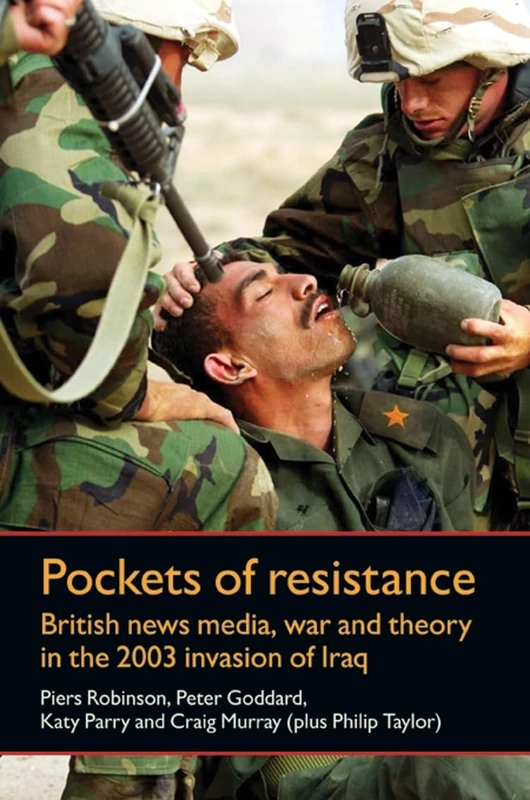
Manchester University Press Pockets of Resistance: British News Media, War and Theory in the 2003 Invasion of Iraq

Price data last checked 83 day(s) ago - refreshing...

View at Amazon

We'll watch every seller, every day. One email when your price arrives.

This is the most expensive it has ever been. Walk away.

£42 today · previous high £42 · all-time low £40

NEW HERE?

Amazon shows you one price. We show you all of them.

Tosheroon watches Amazon prices so you don't have to. Every product on Amazon has a price history — we make it visible. Set the price you'd actually pay, and we'll email you the second it gets there. No app, no account, one email.

WHAT'S ON THIS PAGE

↓ Price chart
when this has been cheap or pricey
↓ Forecast
where the price is heading next
↓ Statistics
all-time high & low, recent range
↑ Price alert
name your number, we'll email you

Price History & Forecast

Grey patches = out of stock. Cheaper = lower on the chart. Hover for exact prices.

Last 8 days · 8 data points (no recent data)

Historical
Generating forecast…
£41.65 £39.47 £39.95 £40.42 £40.90 £41.37 £41.85 14 April 2026 15 April 2026 17 April 2026 19 April 2026 21 April 2026

Price Distribution

Price distribution over 8 days • 2 price levels

Days at Price
Current Price
7 days 1 day · current 0 2 4 5 7 £40 £42 Days at Price

Price Analysis

Most common price: £40 (7 days, 87.5%)

Price range: £40 - £42

Price levels: 2 different prices over 8 days

Description

For scholars of media and war, the 2003 invasion of Iraq is a compelling case to study. As part of President Bush's 'war on terror', the invasion was the most controversial British foreign policy decision since Suez, and its ramifications and aftermath have rarely been far from the news. In the many political and public debates regarding this conflict, arguments over the role of the media have been omnipresent. For some, media coverage was biased against the war, for others it became a cheerleader for the invasion. Where does the truth lie? Drawing upon a uniquely-detailed and rich content and framing analysis of television and press coverage, and on interviews with some of the journalists involved, Pockets of Resistance provides an authoritative assessment of how British news media reported the 2003 Iraq invasion and also of the theoretical implications of this case for our understanding of wartime media-state relations. Pockets of Resistance examines the successes and failures of British television news as it sought to attain independence under the difficult circumstances of war, and describes and explains the emergence of some surprisingly vociferous anti-war voices within a diverse national press. In debunking political claims of anti-war media bias, as well as portraying media-state relations in a more nuanced fashion than in most existing accounts in the field, this study offers a theoretically-grounded starting point for a more nuanced understanding of how and why media report war in the way that they do. Essential reading for scholars, advanced students, journalists and policy makers. Review Like war itself the academic study of media performance in times of war is no less fraught with contending interpretations and opposing claims. Are the media elite driven, independent or oppositional, or possibly all three under changing conditions? Pockets of Resistance, through careful empirical analysis and lucid argument focused on the Iraq invasion of 2003, intervenes into the heart of contemporary debates about media, democracy and legitimised killing and death. An important new landmark and essential vantage point on the contested field of media and war studies. Simon Cottle, Professor of Media and Communications, Cardiff University. Pockets of Resistance reveals that journalists are both more and less autonomous from government sources than is commonly appreciated. This exhaustive analysis of British war coverage during the 2003 invasion of Iraq shows that journalists are just as dependent on official voices and mainstream storylines as they were during the Cold War. But war coverage that supports government positions results more from the patriotism of reporters than from military spin or a heavy reliance on government sources. War coverage that criticizes government positions is often produced by the journalistic imperative to write interesting news stories and from the structure of national media systems, which can create a lucrative audience for contrarian news. Richly detailed and engagingly presented, this important contribution to the literature on press independence places journalists once again at the center of the story. It is a must read for anyone who wants to know how the 24-7 news system covers national security crises, and why that coverage takes the shape that it does. --Scott L. Althaus, University of Illinois Urbana-Champaign Piers Robinson and his co-authors have accomplished that most sought-after goal of academic publishing: delivering both a substantial and original piece of scholarly research, and a useful and accessible test for undergraduate teaching ... The carefully structured approach to explaining and testing different models in the light detailed analysis of the data is what makes the book so valuable as a teaching text as well as a rigorous contribution to the academic study of war reporting. Pockets of Resistance is an impressive achievement, likely to be consulted

Product Specifications

Format
hardcover
Domain
Amazon UK
Release Date
01 September 2010
Listed Since
03 May 2010

Barcode

No barcode data available