£141.39

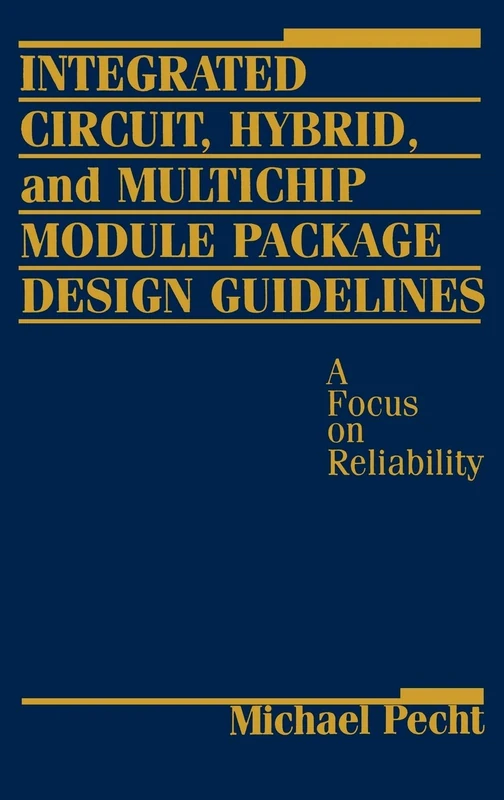
Wiley Integrated Circuit, Hybrid, and Multichip Module Package Design Guidelines: A Focus on Reliability

Price data last checked 94 day(s) ago - refreshing...

View at Amazon

We'll watch every seller, every day. One email when your price arrives.

This is the usual price. Wait for it to drop, or tell us your number.

£141 today · usual range £0–£0 · best ever £133

NEW HERE?

Amazon shows you one price. We show you all of them.

Tosheroon watches Amazon prices so you don't have to. Every product on Amazon has a price history — we make it visible. Set the price you'd actually pay, and we'll email you the second it gets there. No app, no account, one email.

WHAT'S ON THIS PAGE

↓ Price chart
when this has been cheap or pricey
↓ Forecast
where the price is heading next
↓ Statistics
all-time high & low, recent range
↑ Price alert
name your number, we'll email you

Price History & Forecast

Grey patches = out of stock. Cheaper = lower on the chart. Hover for exact prices.

Last 637 days • 637 data points (No recent data available)

Historical
Generating forecast...
£145.47 £131.62 £134.64 £137.66 £140.69 £143.71 £146.73 10 June 2024 16 November 2024 24 April 2025 30 September 2025 08 March 2026

Price Distribution

Price distribution over 637 days • 8 price levels

Days at Price
Current Price
76 days 30 days 1 day 53 days 25 days 24 days · current 72 days 356 days 0 89 178 267 356 £133 £134 £135 £137 £140 £141 £144 £145 Days at Price

Price Analysis

Most common price: £145 (356 days, 55.9%)

Price range: £133 - £145

Price levels: 8 different prices over 637 days

Description

From the Inside Flap Circuit designers, packaging engineers, printed board fabricators, and procurement personnel will find this book's microelectronic package design-for-reliability guidelines and approaches essential for achieving their life-cycle, cost-effectiveness, and on-time delivery goals. Its uniquely organized, time-phased approach to design, development, qualification, manufacture, and in-service management shows you step-by-step how to:Define realistic system requirements in terms of mission profile, operating life, performance expectations, size, weight, and costDefine the system usage environment so that all operating, shipping, and storage conditions, including electrical, thermal, radiation, and mechanical loads, are assessed using realistic dataIdentify potential failure modes, sites, mechanisms, and architecture-stress interactions—PLUS appropriate measures you can take to reduce, eliminate, or accommodate expected failuresCharacterize materials and processes by the key controllable factors, such as types and levels of defects, variations in material properties and dimensions, and the manufacturing and assembly processes involvedUse experiment, step-stress, and accelerated methods to ensure optimum design before production beginsDetailed design guidelines for substrate...wire and wire, tape automated, and flip-chip bonding...element attachment and case, lead, lead and lid seals—incorporating dimensional and geometric configurations of package elements, manufacturing and assembly conditions, materials selection, and loading conditions—round out this guide's comprehensive coverage. Detailed guidelines for substrate...wire and wire, tape automated, and flip-chip bonding...element attachment and case, lead, lead and lid seals--incorporating dimensional and geometric configurations of package elements, manufacturing and assembly conditions, materials selection, and loading conditions--round out this guide's comprehensive coverage.of related interest...PHYSICAL ARCHITECTURE OF VLSI SYSTEMS —Allan D. Kraus, Robert Hannemann and Michael PechtFor the professional engineer involved in the design and manufacture of products containing electronic components, here is a comprehensive handbook to the theory and methods surrounding the assembly of microelectronic and electronic components. The book focuses on computers and consumer electronic products with internal subsystems that reflect mechanical design constraints, cost limitations, and aesthetic and ergonomic concerns. Taking a total system approach to packaging, the book systematically examines: basic chip and computer architecture; design and layout; interassembly and interconnections; cooling scheme; materials selection, including ceramics, glasses, and metals; stress, vibration, and acoustics; and manufacturing and assembly technology. 1994 (0-471-53299-1) pp.SOLDERING PROCESSES AND EQUIPMENT —Michael G. PechtThis comprehensive, fundamentals first handbook outlines the soldering methods and techniques used in the manufacture of microelectronic chips and electronic circuit boards. In a clear, easy-to-access format, the book discusses: soldering processes and classification; the material dynamics of heat soldering when assembling differing materials; wave and reflow soldering; controlling contamination during manufacturing cleanings; techniques for assuring reliability and quality control during manufacturing; rework, repair, and manual assembly; the modern assembly / repair station; and more. The book also provides clear guidelines on assembly techniques as well as an appendix of various solder equipment manufacturers.1993 (0-471-59167-X) 312 pp. Product Description Circuit designers, packaging engineers, printed board fabricators, and procurement personnel will find this book's microelectronic package design-for-reliability guidelines and approaches essential for achieving their life-cycle, cost-effectiveness, and on-time delivery goals. Its uniquely

Product Specifications

Brand
Wiley
Format
Hardcover
Domain
Amazon UK
Release Date
16 March 1994
Listed Since
09 February 2007

Barcode

No barcode data available